
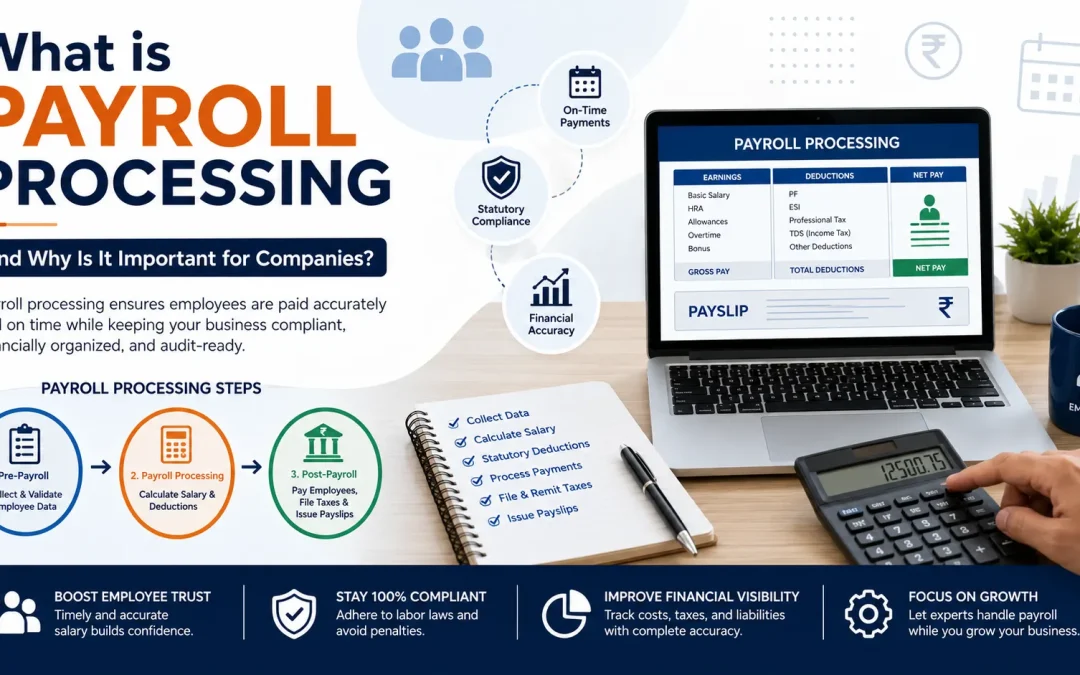
Payroll processing is one of the fundamental aspects of managing a business in general. No matter whether you are leading a rapidly growing startup, a regional business, or a global company, your employees need to be paid correctly and timely.
Nonetheless, many entrepreneurs wonder: What is payroll processing? Why does it take so many operations?
Payroll processing goes far beyond simple check-cutting or direct bank payments. This process involves a number of operations and procedures related to accounting, HR management, taxes and compliance. Incorrect payroll processing may result in high penalties, poor organizational culture and audit problems.
In this article we have outlined for you the main stages of payroll processing, the importance of modern payroll management for businesses and how the best payroll processing companies in India make their clients’ work easy.
What is Payroll Processing?
At its most basic, payroll management is essentially an organizational process of dealing with the money owed by a firm to its workers.
This comprises gathering employee work information, computing gross salary, deducting compulsory statutory deductions, disbursing net salary, and preparing detailed payslips at the end of each month.
There are three fundamental aspects that a payroll processing companies in India:
- Compensation Process: Ensuring all members of the team are paid the due amount according to the agreement on specified dates.
- Statutory Taxation: Computing and remitting taxes (Tax Deducted at Source, Provident Fund, and Professional Tax) to statutory organizations.
- Accounting: Keeping track of salary cost, tax expenditure, and other liabilities of the firm in your general ledger.
Don’t Miss: Payroll Processing Checklist for Foreign Startups Hiring in India
Critical Steps of Payroll Processing
For accurate payroll processing month after month, there is a process that needs to be followed for successful payroll processing. The process of operational steps of payroll processing is classified into three phases, namely, pre-payroll, main processing, and post-payroll phases.
Phase 1: Pre-Payroll Steps
- Formulating Pay Policies of Organization: Formulate internal policies of the organization related to cut-offs for attendance, overtime, leave encashment, and other variable pay components.
- Collection of Payroll Input Information: Collect input information from different departments such as attendance records, leaves, onboarding of employees, resignation, and one-time variable pay requests.
- Validation of Input Data: Validation of attendance data and variable data before entering into the computation process.
Phase 2: Payroll Processing
- Computation of Gross Salary: Total up the sum of basic pay, dearness allowance, house rent allowance (HRA), incentives, and other special allowances during the payroll cycle period.
- Computation of Statutory Deduction: Deduct the legal obligation of tax according to regional labor laws. In India, it includes the computation of Employee Provident Fund (EPF), Employee State Insurance (ESI), Professional Tax (PT), and Income Tax (TDS).
- Final Calculation of Net Pay: Deduct statutory deductions and voluntary deductions from gross salary to find the net payable salary of individual employees.
Phase 3: Post Payroll Activities
- Salary Payment: Submit the prepared files to your banker to process the payment of salaries through direct deposit to employees’ accounts.
- Tax and Deductions Remittance & Filing: Make deposits of withheld taxes and deductions to respective government sites prior to monthly deadlines.
- Payslip Issuance: Provide payslips containing the details of gross salary, statutory deduction and net salary to individual employees.
- Posting to Accounting Ledger: Make the entries in your accounting system.
Why Is Payroll Processing Crucial for Companies?
Payroll typically forms part of an organization’s major operational cost centers. Proper payroll processing companies in India provide immediate financial and cultural gains.
1. Enhancing Employee Moral
Employees depend on their payroll to pay for their needs. Payroll mistakes lead to mistrust in leadership. Effective payroll increases employee morale.
2. Guaranteeing Compliance with Statutes
Labor laws need constant adherence. Failing to pay employees according to statutes results in fines, audits, and lawsuits. Proper payroll management ensures that your organization avoids such challenges.
3. Ensuring Financial Transparency
Effective payroll management offers leaders insight into all labor costs. It ensures that all salaries, overtime, benefits, and taxes are properly managed.
Common Challenges in Payroll Processing (And Solutions To Overcome Them)
Despite having considerable experience in the field, even big companies face issues related to payroll processings. The identification of these problems ensures the development of an effective payroll processing workflow in HRs.
1. Time Card/Remote Access/Leave Application Discrepancies
The discrepancies present in time cards, remote access information, and leave applications lead to ineffective payroll processing. While conducting manual payroll processing, you will find yourself paying excessive overtime and granting paid leaves even though they are not necessary.
Solutions: Connecting your biometric/mobile attendance system with payroll processing system.
2. Coping With The Constant Change in Tax Regime and Statutory Rules
Regular changes happen in tax slabs, statutory contributions limits, and tax filing methods. The tracking of changes in labor law, professional tax by the state, and annual investment becomes difficult due to the existence of several mistakes.
Solution: Utilization of cloud-based payroll software to keep your statutory calculations updated according to the change in tax laws.
3. Delays in Reimbursement and Commission Payments
Submission of expense sheets, travel claims, and sales commissions towards the end of payroll processing leads to reprocessing of calculations for these within tight timelines every month by the payroll processors.
Solution: Cutoff Dates for variable data input every month and use of online claim submission portal systems.
Comparison Between In-House Payroll, Outsourced Payroll, and Automated HRMS
Organizations usually opt for one of the three approaches for handling the compensation process every month:
| Feature / Aspect | Manual / Spreadsheet Payroll | Automated Payroll Management System | Outsourced Payroll Providers |
| Best Suited For | Micro-businesses (< 10 employees). | Growing startups & mid-sized teams (10 to 500+ employees). | Multi-location enterprises or complex international setups. |
| Error Rate | High (due to manual formula inputs). | Low (automated calculations). | Minimal (managed by dedicated experts). |
| Compliance Risk | High (requires manual tracking of legal changes). | Low (software updates compliance rules automatically). | Minimal (provider assumes legal compliance oversight). |
| Operational Effort | High (time-intensive data entry). | Low (streamlined multi-click execution). | Zero internal administrative overhead. |
| Data Security | Weak (unencrypted spreadsheets). | High (cloud encryption, role access controls). | Enterprise-grade (SOC 2, ISO certified). |
Strategic Power of the Payroll Management System
Dependence on spreadsheet-based methods for payroll is no more a safe bet when the headcount increases. Advanced payroll processing companies in India make use of an effective payroll management system to perform repetitive calculations and prevent any possible errors.
Also Read: Complexities of Global Payroll Management: How PEO Fixes It?
Advantages of Using the Payroll Software
- Automatic Calculations: Prevents formula errors while performing calculations regarding the salary structure, attendance records, various incentives, and tax deductions.
- Integration of Data: Ensures seamless integration between various devices used for time tracking, leave management portal, and accounts software without any need for manual data entry.
- Self-Service Portals: Provides facility to employees to access their earnings statements, download tax certificates such as Form 16, upload investment proofs, and leave balances.
- Automatic Compliance: Ensures compliance with changing labor laws, as well as updates on tax slabs and statutory deductions without any manual adjustments in the software.
Role of Top Payroll Processing Services in India
Dealing with multiple states’ statutory laws, various allowance calculations, and changing tax regulations can be tough for in-house HR teams. In order to manage all these complexities in payroll processing, many organizations in India engage professional payroll processing services in India.
Top payroll processing service providers in India provide comprehensive payroll processing services such as:
- Statutory Compliance Services: Calculation and remittance of EPF, ESI, Professional Tax, and TDS (Form 24Q) on a monthly basis.
- Compliance with Multiple States Taxes: Managing state wise PT (Professional Tax) and LWF (Labour Welfare Fund) requirements in case of distributed employees.
- Full & Final (F&F) Settlements: Managing full & final settlement process which involves calculation of notice period salary, leave encashment, and accumulation of gratuity.
Popular Payroll Outsourcing Firms in India
- ADP India: Most suited to large multinational firms that need complex global compliance assistance.
- Quikchex: Provides customised HRMS and payroll outsourcing services for Indian small to medium sized businesses and tech start-ups.
- Wisemonk: Has expertise in Employer of Record (EOR) and payroll management services for overseas firms wishing to pay their employees in India.
- Paysquare: Provides payroll outsourcing, statutory compliance auditing, and accounting services.
- Keka HR and Zoho Payroll: Innovative cloud-based platforms offering self-service portals for payroll processing.
Grow Globally with the Help of InsourceIndia
If you are struggling with payroll, tax compliances, and labor laws related to multiple states, InsourceIndia can come to your help. The services offered by them include reliable EOR, PEO, payroll processing, and recruitment services that will make your task of managing people easier. Contact Insource India to get payroll processing services.
Future Developments that Will Influence the Payroll Sector
As there are shifting trends towards hybrid and remote working environments, there continues to be an innovative trend in the field of global payroll processing.
- Artificial Intelligence and Predictive Analytics: Using the aid of artificial intelligence systems, problems in the payroll processes will be detected before the payroll funds are paid out, while payroll tax errors are detected with predictions for future labor expenses.
- Earned Wage Access (EWA): Unlike relying on the set monthly payroll period, the software system for EWA allows employees to have instant access to a part of their salary.
- Unified Global Payroll Infrastructure: Companies with a multinational presence discard the approach of having different payroll software systems in each country and adopt a unified cloud payroll infrastructure.
Conclusion
It is imperative to understand what is payroll processing and its significance for the success of an organization. Each step performed during the payroll process helps in ensuring safety from any legal issue or loss of confidence from employees.
No matter whether you opt for automation with advanced payroll management systems or choose trusted payroll providers in India, you should ensure having a structured payroll process.
FAQs
Q1. What is payroll processing in business management?
Payroll processing refers to the process of calculating gross employee income, deduction of statutory taxes from the salary, payment of salaries, and record keeping of the same.
Q2. List down some statutory deductions applicable in India during payroll processing?
In India, EPF, ESI, PT, and TDS are some of the statutory deductions which are applicable in payroll processing.
Q3. Explain the difference between Gross Salary and Net Salary?
Gross Salary refers to total salary paid to an employee. It is total income before making any deductions. Net salary is the amount finally paid to the employee after deductions.
Q4. Define full and final (F&F) settlement in payroll?
Full and Final Settlement is the process by which all the remaining finances owed to a leaving employee are calculated and settled. They include salary, notice period, leave encashment, and statutory deduction.
Q5. Why should payroll be outsourced to payroll service providers?
Outsourcing of payroll helps businesses reduce their overheads, eliminate calculation errors, be completely statutory compliant, and focus on business aspects.

 English
  German
  Dutch
Dutch