
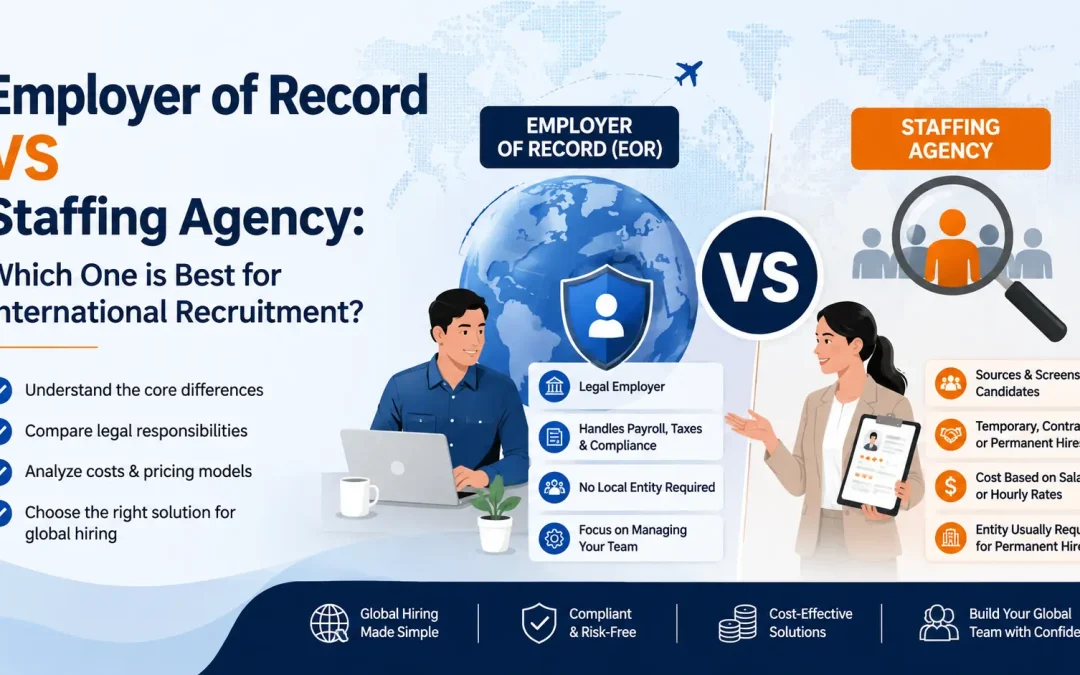
This guide is designed to compare the employer of record vs staffing agency solutions to help you find the one that suits your business needs best.
Traditionally, setting up an international team required significant funding, dedicated legal expertise, and several months’ worth of preparation. Now, thanks to modern technologies, international recruitment is available for companies of any size.
When entering the foreign market, you will typically come across two most common options: the Employer of Record vs the staffing agency.
Although both options assist you in growing your team on the international level, their goals and functions differ greatly. The choice of the wrong solution might result in unwanted taxes, fines, or long-term hiring process.
Don’t Miss: Employer of Record vs. Staffing Agency: Choosing the Right Workforce Solution
Core Concepts Definition
First things first, we need to define each of these services.
What is an Employer of Record?
Thus, what is EOR service? An Employer of Record (EOR) is a company that acts as the official employer for employees in the country where you are not yet registered.
When working with an employer or record agency, you receive all the benefits in terms of administration, finance, and legislation. That means they will manage all your local payroll, benefits, tax payment, and even the right contract.
Although in practice the employer of record solution operates as the official employer, you will be fully in charge of your worker. You will control their day-to-day work, set their objectives, and evaluate their performance.
Staffing Agency Meaning
When you ask yourself, “what is staffing agency,” remember that it can be seen primarily as a tool for recruiting.
A staffing agency has a task of sourcing and evaluating candidates for positions. Companies use staffing agencies to get qualified workers fast for different reasons: to fill their empty positions, to overcome their skills shortages or to cope with workload peaks.
The most common activities of staffing agencies include:
- Temporary staffing – finding candidates for short-term assignments.
- Temp-to-hire – evaluating candidates in a trial period before making an offer of permanent employment.
- Direct placement – finding candidates for full-time permanent positions in your company.
After a staffing agency makes placements, its work is done, unless they handle temporary staffing assignments. In case of direct placement, you will take all legal responsibilities for this candidate.
Employer of Record vs Staffing Agency: Head-to-Head Comparison
| Feature/Aspect | Employer of Record (EOR) | Staffing Agency |
| Primary Function | Infrastructure, compliance, and ongoing payroll execution. | Candidate sourcing, screening, and talent acquisition. |
| Legal Employer | The EOR service holds the legal employment risk. | Your company (for direct hires) or the agency (for temp placements). |
| Sourcing Candidates | Typically requires you to bring your own candidate. | Actively sources, interviews, and presents candidates. |
| Talent Focus | Long-term, full-time core team members. | Temporary workers, project contractors, or fast volume hires. |
| Pricing Structure | Flat monthly fee per active employee. | Percentage of first-year salary or markup on hourly rates. |
| Entity Required? | No local entity needed in target countries. | Entity usually required for permanent international hires. |
Differences between Staffing Agencies and EORs Explained
1. Hiring Process Stage
Staffing Agencies function at the early stage of the hiring funnel. The task of these agencies is to source resumes, perform preliminary screening, and find a match to your job opening.
EOR Service appears at the late stage of the hiring funnel. When you select the candidate you wish to employ from abroad, an EOR Service prepares local employment agreements for him/her, registers the person with the local tax authority, and performs payroll.
2. Legal Responsibility
Global expansion involves working within unknown labor laws, statutory severance payments, mandatory paid vacation policy, and various tax rules.
All the above mentioned legal responsibilities are transferred to the EOR. Since the EOR employs the person you wish to work with using their own legal entity, they will be responsible for any mistakes in the labor compliance process.
In the case of a regular staffing agency, you are still exposed to the risks of cross-border labor compliance when employing the candidate as your direct employee.
3. Cost and Pricing Models
- EOR Pricing: In most cases, EORs charge clear and predictable monthly fees per employee hired (ranging from $200 to $600 per month). It makes budgeting easy.
- Staffing Agency Pricing: Staffing agencies usually take a percentage-based fee for permanent placements (ranging from 15% to 25% of the candidate’s yearly first year salary). When it comes to temp candidates, they usually charge a continuous markup fee based on their hourly rate.
Total Cost of Ownership (TCO): EOR Versus Staffing Agency
For proper planning and budgeting when hiring globally, one needs to go beyond initial prices and consider the financial commitment that will follow.
Financial Considerations in Case of Staffing Agency
In case of a staffing agency, the costs involved are highly front-loaded in case of direct hires and vary in case of temporary hires:
- One-time Fees: Direct placement of an experienced software developer with a salary of $120,000 through a staffing agency costs $18,000 to $30,000 in initial agency recruiting fees.
- Ongoing Markup in Hours: In case of temporary hires, there is an additional charge (which varies from 25% to 50%) that is charged on the hourly wage of the employee.
EOR Financial Dynamics
The EOR service is based on the predictability of ongoing operational costs:
- Predictable Overhead: The fixed fee charged per month for each member of staff guarantees clear visibility of costs and ease of forecasting across all international markets.
- Zero Upfront Cost: No need to pay $20,000 to $50,000 and upwards per target market on the cost of establishing your corporation abroad.
Understanding Work Arrangements: Employer of Record vs Contractor
Companies looking for global hiring solutions often evaluate their options by comparing using an employer of record vs contractor approach. It’s vital to understand the differences between them to secure your company.
Hiring Independent Contractors
Using independent contractors for your business sounds easy and cost-effective. You sign a service agreement with the contractor, and they manage all taxes and benefits themselves.
Nevertheless, hiring too many contractors means high worker misclassification risk. In case local labor authorities identify that your contractor works like an employee because of working time, tenure, or exclusivity, you will receive huge fines and back tax bills.
Transition to an EOR Structure
With the help of EOR service technology, you will be able to transform important international contractors into properly employed staff members without establishing foreign subsidiaries. EOR services include local health insurance, pension contributions, and paid vacations, which allow keeping the best professionals and being safe from any legal risks.
Advantages of EOR for Your Strategy
There Is No Need to Set Up Local Legal Entity: Establishment of a legal entity in another country might require half a year and thousands of dollars on legal consulting. EOR guarantees immediate access to the international market.
- Complete Adherence to Labor Laws: Labor laws change very often. EOR is watching for any changes in tax law, process of dismissal and required social benefits.
- Protection of Intellectual Property Rights: EOR agency guarantees the transfer of all intellectual property rights of work products, code and inventions of international workers into your ownership.
- Centralized HR & Payroll Services: It eliminates the necessity to coordinate several regional payroll services in different time zones and currencies.
The Strategic Benefits of Using a Staffing Agency
- Quick Talent Recruitment: Staffing agencies have their talent pools and candidate databases that can be used to hire talent quickly.
- Industry-Specific Knowledge: Industry-specific agencies will have knowledge about the industry salaries and available skills.
- Flexibility to Increase Temporary Workforce: Staffing agencies can help increase your temporary workforce rapidly.
Which Option to Go For?
Consider Employer of Record (EOR) If:
- You have found international talent and want a legal and quick process to hire them.
- You need to give competitive statutory perks and establish your international team permanently.
- You want to explore new markets without creating costly corporate entities locally.
- You want to make your international contractors into employees to avoid any misclassification issues.
Go for a Staffing Agency If:
- You don’t have recruitment resources internally and require external assistance in sourcing qualified candidates.
- You require temporary, contractual or seasonal employees for short-term projects.
- You wish to source direct hires in a market where you already have an existing corporate entity.
Reliable EOR services in India help you hire employees, handle payroll, and stay fully compliant without the need to establish a legal entity. Contact us at Insource India to find your reliable EOR Service
Conclusion
The choice of employer of record vs staffing agency comes down to your current business needs. In case your immediate problem is that of sourcing talent fast, then a staffing agency will be the one to provide you with these services.
However, if your objective is that of international expansion in the long run, payroll and seamless hiring overseas without incorporating in a foreign country, then an employer of record agency is the way to go.
FAQs
1. What is the difference between an Employer of Record and a staffing agency?
The staffing agency concentrates on recruiting and candidate sourcing, while an Employer of Record (EOR) concentrates on infrastructure, becoming legally responsible, conducting payroll processing, and handling local taxes, statutory benefits for international employees.
2. Is it possible for an EOR provider to recruit candidates for me?
Whereas an Employer of Record platform is mainly designed to manage legal employment, onboarding, and payroll processing, modern EOR providers are also partnering with talent networks or have recruitment services as an additional feature to help you source global talent.
3. Is it possible to combine the services of a staffing agency with an EOR service?
It is possible. Many companies that are growing cooperate with a local staffing agency in order to source top-quality global candidates and then use EOR service for onboarding and payroll processing of these workers.
4. Can an EOR be used for recruiting full-time remote workers?
Yes, the EOR system is tailored for long-term strategies in international recruitment. With the help of the EOR system, your company will provide your employees with the necessary rights, benefits, and payroll security without opening an office.
5. How will an EOR system shield my company from worker misclassification?
The EOR recruits workers through valid local employment agreements that meet all local labor standards. Using an EOR will prevent your company from any worker misclassification charges.

 German
  English
  Dutch
Dutch