
Recruiting employees in another country is not just about identifying the correct employee and making the hiring process.
It includes collecting the necessary information, conducting verification, preparing documents for employment, and taking care of payroll issues. However, when the employer makes the hiring process through the employer of record in India, this process becomes more organized since the EOR takes care of all the processes for the employer.
Having the knowledge about the documents for hiring employees in advance will allow you to make the onboarding process quicker. Each document plays its own role in the hiring process.
Why Are Documents Important When Hiring Employees in India?
The documentation of employees enables identification of the employee, establishment of the employment relation, payroll issues, and determination of the benefits that apply to him or her.
It is especially critical for employers recruiting in India using the services of an EOR since the EOR would need the details of the employees to be able to draft employment agreements and to handle the payroll issues as well as other statutory issues.
The specific items may differ based on the position and salary level of the employee, geographical and industry sector, and the compliance process followed by the EOR.
Documents Needed for Employment in India
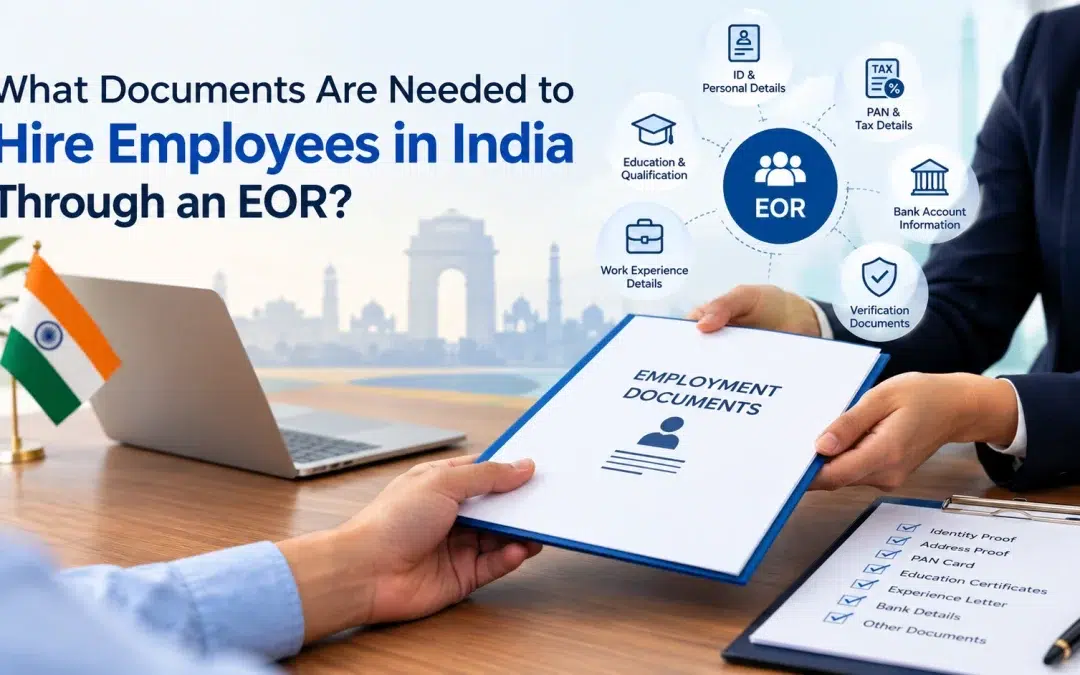
The required documents for working in India may include personal identification, address proof, financial proof, education or professional qualifications, and previous employment details wherever applicable.
Examples of common documents required for employment in India are as follows:
- Identity proof issued by the government
- Address proof
- PAN card
- Bank details
- Photo ID (passport size), if required
- Educational certificates
- Professional qualifications, if any
- Previous employment certificates
- Experience letter/relieving letter
- UAN/provident fund related details, if any
- Any other information required for statutory compliance
It is not necessary that each and every one of these documents be submitted by each employee. The list of documents required depends on the circumstances of each employee and the legal requirements of employment.
Don’t Miss: Payroll Processing Checklist for Foreign Startups Hiring in India
Key Employee Onboarding Documents in India
The documents required by Indian employers for onboarding employees will aid in verifying the identity of the employee and obtaining the information required to maintain an accurate employment record.
- Identity Proof
The identity proof of the employee is generally required to verify his/her identity. The identity proof can be documents such as Aadhaar, passport, voter ID, or driving license, based on the requirement of the organization.
It is advisable for organizations/Employer of Record (EORs) to only collect data that is required for the purposes of employment and handling the information securely.
- PAN Card
The PAN card is significant in the payroll and income tax process in India. It is essential for the employer to have details of the employee’s PAN.
It is important that the details of the name of the employee provided are accurate.
- Proof of Address
Proof of address may be required to prove address for purposes of employment, payroll processing, statutory procedures, or any other administrative matter.
Based on the requirement of the employer/EOR, acceptable proof may consist of certain government-issued documents, utility bills, rent documents, or any other accepted documents.
- Bank Account Information
Information related to the bank account of the individual is needed in case of electronic salary payment to the employees. The individual will have to provide information such as the bank account number, IFSC code, etc.
In case the information provided is wrong, there will be delays in salary processing.
Employee Verification Documents
Verification is another critical aspect of onboarding. **Verification documents** enable the employer or EOR to verify information provided by the candidate.
The process of verification can involve:
- Identity verification
- Address verification
- Educational verification
- Employment verification
- Professional qualifications verification
- Reference checking
- Background check if relevant and legal
The level of verification usually depends on the type of job being done. For instance, if it is a sensitive job that deals with financial details, then the candidate must go through more extensive verification than other jobs with no such issues.
Employers must make sure that they conduct verifications within the boundaries of the law and privacy regulations.
Joining Documents for Employees in India
After the candidate accepts the offer, the organization or EOR may require some joining documents for employees based in India for completing their onboarding process.
Some of which could include:
- Offer/appointment letter:
The employee may receive an offer or employment agreement letter indicating important things like the position, salary, working conditions, notice period, and so forth.
- Tax and payroll information
Information about the PAN, bank accounts, and other details may be gathered to prepare the payroll of the employee.
- Benefit information
As per the eligibility criteria, the employee may require information for providing details related to the provident fund, insurance, gratuity, and other benefit plans.
- Emergency contacts:
The employer may ask for the employee’s emergency contacts for administrative and employee welfare reasons.
- Policies acknowledgment:
The employee may be required to acknowledge the policies of the company related to confidentiality, information security, acceptable use, behavior in the workplace, and so forth.
The actual checklist for joining will vary from employer to employer, depending upon the specific requirements involved and who the particular employee is.
EOR Onboarding Documents Definition
With the use of EORs, there is one more level of documentation, since EORs become responsible for managing the official employment process.
EOR onboarding documents will be those which are necessary for:
- Creating a profile of the employee
- Drafting of the employment contract
- Creating a payroll
- Completing all required statutory registrations
- Setting up the benefits package
- Verification of information
- Storing of employment-related data
- Salary payment
- HR administration processes
The EOR can provide the employer with an onboarding checklist.
What Does an Employer Need to Provide to an EOR?
While the responsibility of submitting personal and professional details lies with the employee, the hiring company must also submit crucial information to the EOR.
This may include:
- Job Title/Role of the Employee
- Date of Joining
- Salary/Benefit Structure
- Location of Employment
- Mode of Employment
- Type of Employment
- Leave/ Benefits Information
- Managerial Report Information
- Policies of the Company
- Requirement specific to the role
Submission of the above information will help the EOR in preparing the employment and payroll documents before the arrival of the employee.
How an Employer of Record in India Can Help
In the case of international companies, directly hiring in India may include employment processes, payroll, documentation of employees, and more.
An EOR service in India will ease the procedure by being the local employer for the employees while the client company takes care of the management of the employee. The EOR handles essential administrative tasks like employment contracts, payroll, administration of benefits, and compliance procedures.
Thus, the business will only need to worry about hiring and management of the employees.
Conclusion
It is very crucial to have all necessary documents in place when setting up an efficient and hassle-free employee onboarding process in India. The documentation that includes ID proof, PAN details, address proof, bank details, employment history, and others will help build up an employee profile.
If your company hires through EOR, you may expect a much more streamlined process since the EOR helps to structure and manage the collection of all necessary information about the employee.
Through proper preparation of the required documentation for employee hiring, your business may speed up the onboarding process and make it more pleasant for both HR professionals and the new recruits.
FAQ’s
- Which documents need to be submitted by a person for the purpose of hiring in India?
Identity proof, PAN number, proof of address, banking details, pictures (if necessary), certificates, etc., could be the common documents that could be asked of a candidate by the employer.
- Which are the important documents required at the time of employee onboarding in India?
Some of the important documents that could be required for the purpose of employee onboarding could be an employment letter, identity/proof of address, PAN card, banking details, tax-related information, benefit-related documents, emergency contacts, etc.
- Are documents collected from the employees directly by the EOR?
In most cases, the EOR could take care of the entire onboarding process along with collecting all the necessary information for establishing the relationship between the two parties.
- Is verification of the employee mandatory for every job?
It is not always the case. Verification will depend on the job profile, company policy, and many other factors. It could involve verification of identity, qualifications, work experience, references, and others.
- How does EOR make it easier to hire employees in India?
EOR can perform several functions related to employment administration, such as employment paperwork, payroll, benefits management, and so on. This makes it possible for foreign companies to employ workers in India without having their own employment management structure locally.

 German
  English
  Dutch
Dutch