
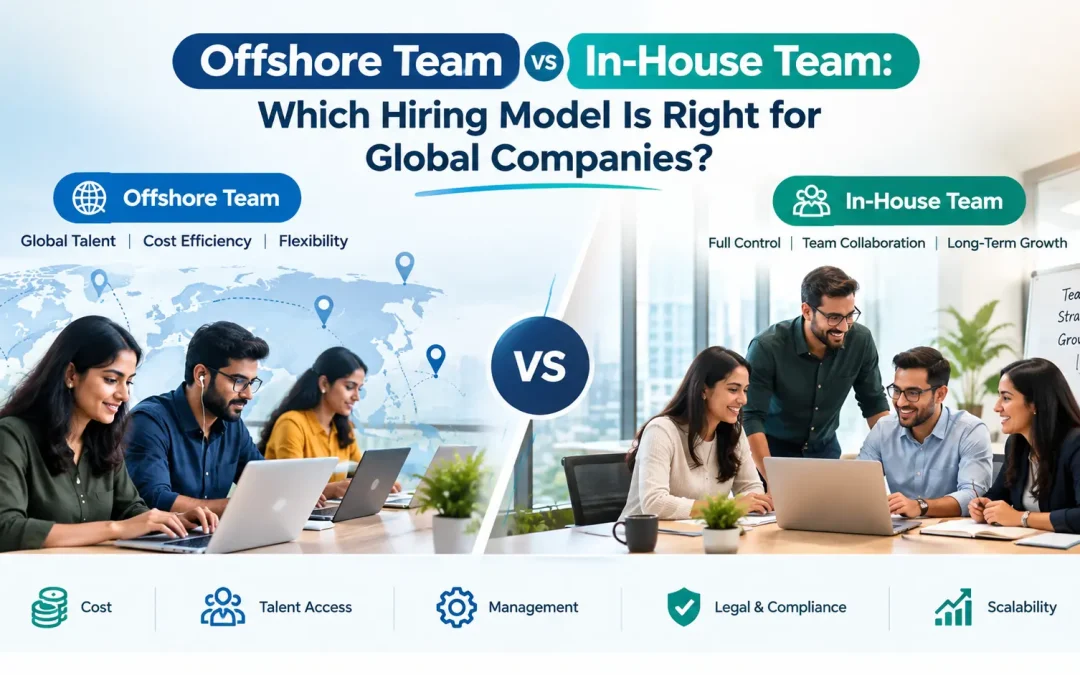
The options available to today’s global firms for creating their workforce have never been better. Rather than hiring all the staff locally, firms may choose to create an in-house workforce, utilize an offshore workforce, or use a combination of both approaches as per their business requirements.
In many cases, opting for either of the two kinds of workforce might have implications on the cost of hiring, talent availability, management, scaling, and overall business operations. This will depend on what kind of workforce a firm wants and how much control it needs over the hiring and daily processes.
For firms venturing into new markets like India, an awareness of the two models will make international workforce planning easier.
What Is an Offshore Team?
The offshore team is a collective of professionals that work for the firm coming from another country and usually from the place where the company can benefit from a specific talent pool and run business cost-efficiently.
For instance, if the headquarters of a firm is situated in the USA, it will form a team of software developers in India. The team develops software for the company based in the United States but works from India.
This team might include software developers, designers, marketers, customer service representatives, data analysts, financial experts, etc.
Firms use this method when they need a large talent pool but do not want to develop a full-scale organization in every country where they hire workers.
What Is an In-House Team?
The in-house team represents workers that are recruited directly by the company and managed within the organizational structure of the company.
For instance, a technology company located in the United States may hire developers, project managers, designers, and other workers directly into its staff.
These duties include but are not limited to recruitment, hiring agreements, payment of salaries and benefits, compliance with regulations, management of the workers, and others.
Such an option can give companies more control over their personnel and prove to be useful in those cases where workers need to cooperate with the teams inside the company.
Offshore Team vs In-House Team: Differences
When speaking about offshore team vs in-house team, there are certain aspects that should be taken into account.
| Factor | Offshore team | On site team |
| Access to talent | Access to talent from around the world | Local talent access |
| Cost | Cost-effective | Employment is often costly |
| Rekrutierung | Global recruitment | Reliant on local recruitment |
| Management | Cross-border management | More straightforward management |
| Legal | Knowledge of local hiring laws | Legal matters are already addressed |
The optimal choice depends on the preferences of the company.
Also Read: PEO vs In-house HR: Which Model Delivers Better Business Value?
Advantages of an Offshore Team
One of the key advantages of using an offshore workforce is the ability to draw from a larger talent pool.
A company looking for specific technical expertise might find it challenging to hire enough qualified individuals in their domestic market environment. An international search will make it possible to find individuals with various skills and experience.
Cost efficiency is another factor to consider. The cost of salaries and employing individuals varies from country to country. Therefore, using a workforce from a talent-rich market helps a company keep workforce costs low.
Another benefit of an offshore workforce is that it can help ensure business continuity. Operating in different time zones allows for some work to be done after the working hours of the primary team.
This can prove especially helpful for tech companies.
Challenges of an Offshore Team
There are also issues associated with offshore hiring.
The process of communication may become more complex due to the fact that the teams may operate within different time zones, cultures, and approaches to communication.
Issues associated with data protection and intellectual property should be considered, especially in case the offshore workers deal with confidential information about the company’s business.
An important issue to be considered is also local employment legislation. The hiring of the employees in another country may be regulated by other requirements concerning payroll, taxation, compensation, etc.
That is why an international hiring structure should be established in advance.
Advantages of an In-House Team
The in-house team offers firms increased direct control over recruitment and management of employees.
Employees usually work with in-house management and other departments, making it easy for them to communicate and collaborate.
The in-house team is able to gain good knowledge of the firm’s culture, products, processes, and overall goals.
If employees need to be involved in very sensitive tasks or need to work closely with top management all the time, keeping them in-house might be a better approach.
Firms have better direct control over training and evaluation of employees as well.
Challenges of an In-House Team
One of the main difficulties with an in-house approach is the problem of expense and intricacy that comes from having to maintain their own staff.
Recruitment, salary costs, employee benefits, office facilities, human resources, and compliance with employment regulations need to be dealt with.
Additionally, recruitment may also slow down in cases where a business competes with other businesses for talent locally.
When a company is growing fast and looking to expand its operations, this could prove difficult because there may be no specialized talent available.
What Is an Offshore Hiring Model?
The offshore hiring approach enables organizations to create or utilize a workforce in a foreign country without disrupting business activities in the main place of operation.
Here are different approaches in setting up this type of business model. Organizations can set up a separate legal entity, collaborate with a recruitment agency, or make use of the Employer of Record.
Different circumstances will determine which approach would be ideal based on the number of people, duration of the process, degree of control, and other local considerations.
For those that are considering entering the Indian market for the first time, it might not always be feasible to establish a separate legal entity just for the purpose of employing a few people. EOR services offer the next best thing, where an organization retains overall control of the employee’s duties.
India as an Offshore Hiring Destination
The Indian economy has emerged as a major hub for organizations to form international teams, especially in the domain of technology and business services.
Availability of a large pool of professional employees has enabled businesses to tap into expertise in software development, data sciences, artificial intelligence, finance, customer service, design, and other areas.
This trend has led to the formation of offshore development companies in India that assist businesses in software development, engineering, IT services, and other services.
But in choosing an offshore location, organizations must look beyond the technical skills and consider aspects such as employment compliance, communication, data security, organization, and scalability.
Offshore Team vs In-House Team: Which Should You Choose?
The decision on whether to have an offshore team or in-house team cannot be universal.
An in-house strategy would work well where direct control and close collaboration are the topmost considerations.
An offshore strategy could work well where a firm wants access to special international expertise, workforce flexibility, or an effective means to grow at minimal cost.
A number of multinational companies end up adopting the combination approach. This is where they have their own core in-house staff for certain critical roles and also establish offshore teams for other tasks.
This will enable a firm to enjoy direct control along with special international expertise.
How Insource Can Help Global Companies Hire in India
The expansion of a workforce internationally involves not only identifying skilled personnel but also taking care of employment agreements, payroll, benefit schemes, legislative compliance, induction, and human resource management.
Insource supports global corporations with their workforce establishment and management in India through the provision of local employment and manpower solutions. With the use of EOR services, firms will be able to leverage the talents in India and reduce some administrative burdens of international recruitment.
For any business, whether it creates its offshore team for the first time or expands the existing global workforce, the help of a local partner might be beneficial.
Conclusion
It all boils down to a company’s objectives, budget, skill requirements, preferences of management, and future plans.
An in-house workforce is a means for ensuring great integration into the organization and good control, whereas an offshore workforce can be a good option for access to global talent pool and greater flexibility for businesses.
When a business is considering its global recruitment plan, then taking up an offshore model could be one good way for having access to a huge talent pool. Provided that proper employment structure is put in place, businesses can create efficient work forces without letting the intricacies of international hiring hamper their development process.
Conclusion
1. What factors should a company consider when choosing between an offshore and in-house team?
Companies should consider factors such as budget, access to talent, required level of control, collaboration needs, scalability, recruitment requirements, and local employment compliance before choosing a workforce model.
2. Is an offshore team suitable for companies entering a new market?
Yes. An offshore team can help companies access local talent and expand their workforce without immediately establishing a full-scale organization in the new market.
3. What are the main challenges of managing an offshore team?
Common challenges include differences in time zones, communication styles, work cultures, data protection requirements, intellectual property concerns, and local employment regulations.
4. Can a company combine offshore and in-house teams?
Yes. Many companies use a combination of both models by keeping critical roles in-house while using offshore teams for specialized skills, flexibility, or cost-efficient workforce expansion.
5. How can an Employer of Record support offshore hiring?
An Employer of Record can help companies manage local employment requirements such as employment agreements, payroll, benefits, and compliance while the company maintains control over the employee’s day-to-day work and responsibilities.

 German
  English
  Dutch
Dutch