
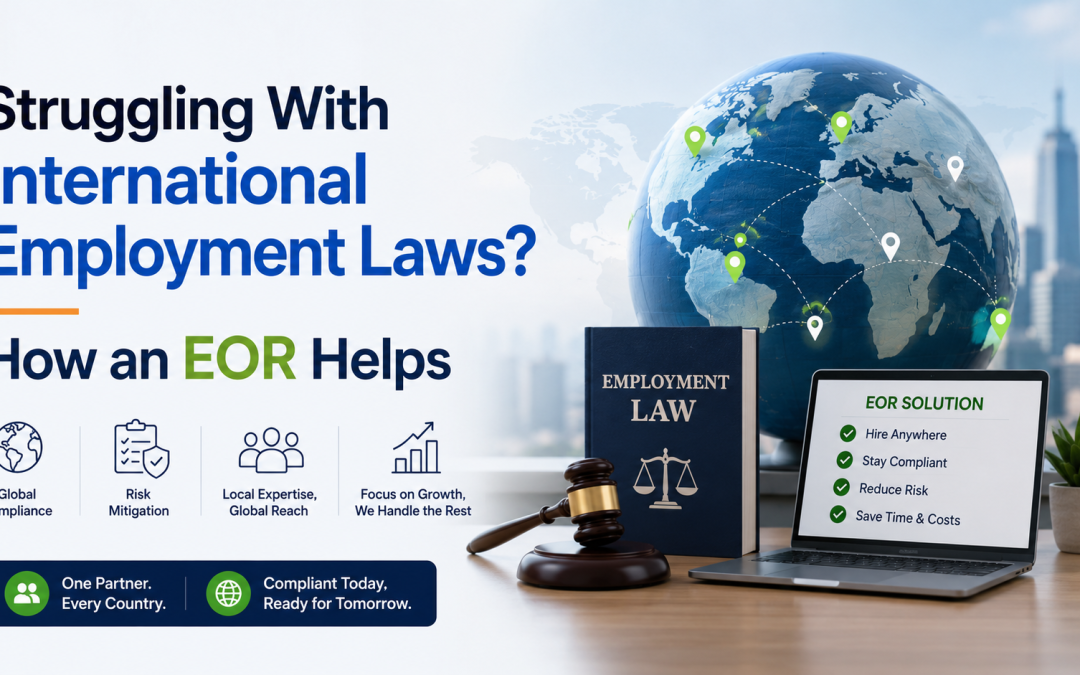
Key Highlights
- Manage complex legal requirements when hiring abroad with an Employer of Record (EOR)
- Simplify your hassles around tax structures and statutory filings
- An effective EOR helps to eliminate the entity set up to hire in countries like India without investing in time and money to set up a local legal entity.
- Navigate through global hiring regulations with the local experts to protect your organisation from legal pitfalls
How to Hire Employees in India Without Legal Risk (EOR Guide for SMEs)
Any growing company is always excited to expand its business beyond its country of origin. However, it often poses significant challenges. The most complex ones is navigating through the complex legal requirements of hiring abroad.
The legal landscape in countries like India is quite diverse, ranging from statutory benefits to complex payroll structures. Indian labor laws, tax structures, and statutory compliance make direct hiring complex for foreign companies.
This is exactly where you need an Employer of Record (EOR). It is your organisational strategic asset to navigate the local legal requirements in hiring abroad. In this guide, let’s understand how your organisation can make the best use of this EOR.
How International Employment Laws Burden the Growing Companies?
When companies, particularly those trying to scale up, decide to hire talent in a new market like India, they encounter legal requirements for hiring abroad. While some consider these tasks administrative, they are not. In fact, they are crucial legal obligations and if overlooked or mismanaged, can result in severe legal penalties and operational disruptions.
The complexities in hiring abroad often include:
- Every region has its own set of legal requirements, like mandatory filings and reporting. Your organisation must handle them efficiently right from the beginning.
- Business newcomers often stumble across the unfamiliar tax brackets and payroll regulations.
- Understanding local regulations concerning leaves, insurance and statutory benefits is of paramount importance to stay compliant with the employment law international hiring procedure.
Why Hiring in India Is Legally Complex for Foreign Companies?
Hiring employees in India for your foreign business poses a formidable challenge. The regulatory environment here is multi-layered, demanding strict adherence to local payroll compliance. Entity requirement stays at the core of this complexity. A foreign firm cannot directly hire local employees in India. They need to have a local legal subsidiary. However, this process consumes months. Then comes the complexities of local labor laws that mandates the requirements of specific social security contributions, most notably PF and ESIC contributions. These are statutory obligations requiring monthly filings, precise tax-holdings (TDS) and electronic challan cum returns (ECRs).
How Does EOR Work in Cross-Border Hiring?
An Employer of Record (EOR) are the legal employer of your organisational staff within a particular host country. While EOR handles all technical complexities of cross-border hiring laws, the hired employees work exclusively for your organisation. They follow your organisational leadership.
Here’s how it benefits your organisation:
No Need For A Local Entity Setup
Setting up a local entity in any given foreign country takes a good amount of time. The process is quite expensive as well. There are significant registration worries. However, an EOR facilitates you to skip this phase completely and build with your operational team in India in a structured form.
Managing Regulations of Global Hiring
Regulations change frequently. It therefore becomes crucial for your organisation to stay up-to-date with the labour codes and new tax mandates. Moreover, constant vigilance is required. A professional EOR service offers access to local experts who are more familiar with these local regulations.
Streamlining Your Organisational HR and Talent Acquisitions
Beyond compliance, an EOR partner also assists with the entire employment lifecycle. This lifecycle management ensures that your hiring process is compliant with the local standards while fulfilling your global business expectations.
“Estimate your India hiring cost without setting up an entity” with InsourceIndia.
The Strategic Advantage of An Effective EOR
An EOR immediately solves your international employment law issues. However, its long-term benefit is its ability to adopt a true insourcing model. It is not like your traditional outsourcing service, where you need a third-party vendor. It helps you to:
- Retain your IP ownership exclusively with you.
- Instill your corporate values, rituals, and communication styles in your hired pool.
- Retain all of your institutional knowledge and expertise.
- Hold reins of performance appraisals and compensation structures.
| Aspect | Insourcing (EOR Enabled) | Traditional Outsourcing |
| Operationele controle | Full control over decisions | Limited control; dependent on vendor |
| Legal Employer | EOR (Local Partner) | Third-party Vendor |
| Employee Relationship | Direct connection to your brand | Connection only to the vendor |
| Knowledge Flow | Stays internal to your company | Resides with the vendor |
An EOR-supported model helps your organisation with:
- To retain direct ownership over your hired team.
- Your process and expertise stay on your grounds.
- Your new hires share your organisational goals and feel worthy to invest in your organisational success.
Why Choose InsourceIndia for an Effective EOR?
Building a new team with local experts in a new geography like India should not obstruct your core business activities. The Indian market offers a vast talent resource and a growing startup ecosystem. It is obvious that businesses fear the complexity of the new environment and get easily overwhelmed.
In such scenarios, InsourceIndia enables international businesses to penetrate the market, build and scale their operations. We follow a structured insourcing approach to remove the operational disturbances of global expansion.
Also Read : Insourcing vs Outsourcing in India: What Global Companies Should Know
Key Benefits of Our Insourcing Model and EOR:
- Moves your organisation forward with a robust internal system.
- Avoids the local registration hassles, tax structures and statutory filings.
- Leverage local expertise to build a strong supply chain network.
- Build a local team that genuinely owes its heart and faith to your organisation.
Conclusion
Struggling with legal requirements, hiring abroad shouldn’t stop your organisation from its global expansion. An EOR is a secure, compliant and efficient bridge to root your organisational existence in a new geography. It effectively handles your global hiring regulations and allows you to retain full leadership over your business operations. With efficient EOR partners such as InsourceIndia, you build a team that truly belongs to your organisation.
So, do not let the legal hiring compliance of a new geography slow down your global vision. Build your high-performing local experts team in India today with InsourceIndia.
FAQs
Q1. What are the hurdles to primary legal requirements hiring abroad?
The hurdles of primary legal requirements hiring abroad include adhering to:
- Local tax structures
- Payroll regulations
- Statutory filings
- Mandatory employee benefits
Q2. How does an efficient EOR help your organisation to navigate the complexity of international employment law hiring?
An effective EOR works as your organisation’s legal employer. It takes charge of local compliance, HR and payroll to mitigate risks while allowing your company to have full-fledged operational control.
Q3. Can we hire a dedicated Indian team without registering a local legal entity?
Yes, InsourceIndia facilitates the global companies to build and operate their teams in India. We follow a structured approach without asking the companies to register their local legal entity.
Q4. Who benefits most from these services?
An effective EOR is beneficial for long-term operational control and a stable global support team. Below is a list of direct beneficiaries of these services:
- SMEs
- Mid-sized companies
- Larger corporations

 Dutch
Dutch  English
  German