
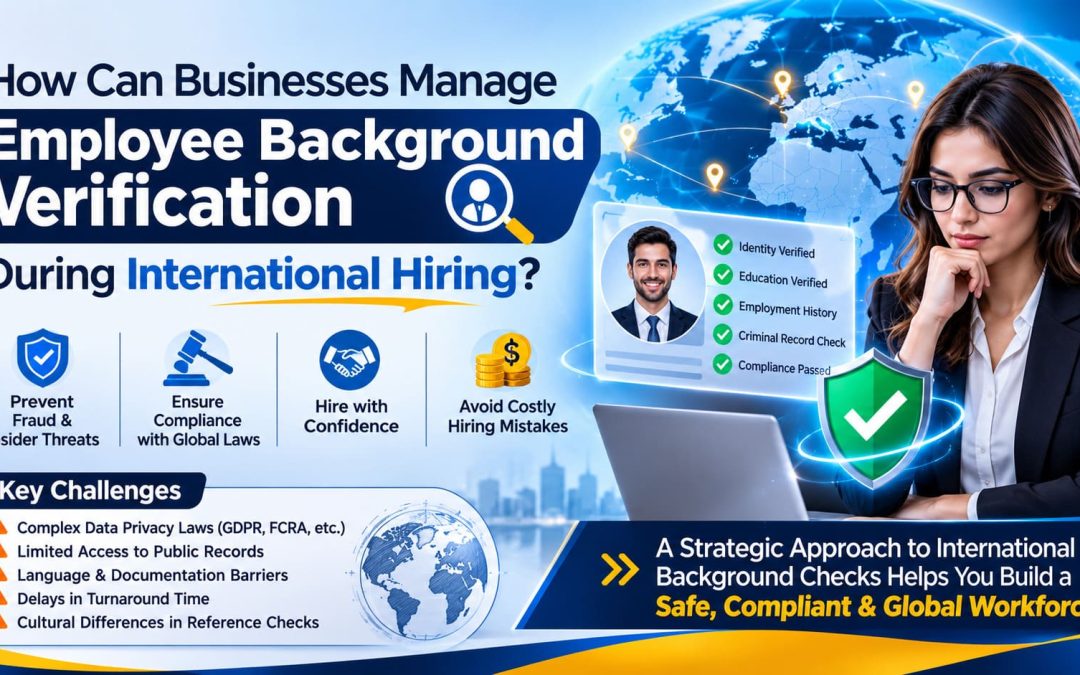
Recruiting abroad provides access to exceptional abilities, untapped markets, and around-the-clock work hours. But hiring a foreign individual poses its own set of challenges. Your potential hire could lie about his job title, provide a degree from an unaccredited college, or not mention an employment prohibition in his own country.
Doing domestic checks for employment screening is easy. Conducting international employment checks is difficult. Each nation has unique privacy regulations, employment guidelines, and record-keeping procedures. What is considered acceptable practice in the USA or India may be absolutely off-limits in Germany or France.
But by following a systematic approach to cross-border recruitment and screening, companies will be able to recruit internationally without breaking local laws or delaying the process of on-boarding candidates.
Why is Employee Background Verification Essential for International Hiring?
Hiring a person whom you might never see in real life requires placing your faith on facts. There are four reasons why an Effective employee background verification services helps protect your company:
- Preventing Resume Fraud: Credential padding takes place everywhere. Checking certificates and work experience helps make sure the candidate really has all necessary skills.
- Preventing Insider Threats: Your international employee hired remotely will be able to access your customer data or your company’s software or financial systems starting from the first day of work.
- Adhering to Client Requirements and Government Regulations: Many industries, such as finance, healthcare, enterprise software development, and others require documentation of compliance screening for all employees and contractors.
- Saving Money on Recruitment: Hiring the wrong person costs your company lots of money. Losing even one mid-level employee costs thousands of dollars.
Also Read: What Documents Are Needed to Hire Employees in India Through an EOR?
Main Challenges to Conducting International Background Checks
Before conducting employers background check on employees internationally, HR departments need to be prepared to overcome five major hurdles:
1. Complex and Conflicting Data Privacy Regulations
Privacy laws cover all aspects of how you handle collecting, storing, and transferring data about your candidates internationally. GDPR in the EU requires you to have a legitimate purpose for each check. The Indian Digital Personal Data Protection Act requires you to obtain detailed consent. Brazil uses LGPD, and the USA uses the FCRA. Using the same generic consent form everywhere is almost guaranteed to violate national laws.
2. Unpredictable Availability of Public and Criminal Data
Background checks on criminal history may differ dramatically from country to country. Some nations have comprehensive national databases on criminal records. Other nations require a background check either at the district, police station, or court level. In some countries, such as Germany, the employer can’t ask for a criminal record; it is up to the candidate to apply.
3. Linguistic Issues and Formatting Issues
Transcripts, national identity documents, and job verification documents usually come in local languages with variations in naming systems or calendar systems. Misinterpreting the translation of the document could cause false rejections or overlooked differences.
4. Delays in Turnaround Time
Local document checks take three to five working days. Foreign document checks could take two to four weeks. Some universities in particular geographic regions shut down for long periods of time during seasons and court document checks require physical presence in the court.
5. Cultural Differences in Reference Checks
Several countries in Europe and Asia issue neutral reference letters to verify the position of employment and date of employment in order to avoid legal issues.
International Background Checks that are Essential in Nature
An extensive employer’s background check is tailor-made depending on the position and the country in which the individual is based. Below are the common types of international background checks:
| Verification Type | What It Confirms | Global Considerations |
| Identity & Right-to-Work | Validates passport details, national ID numbers, and legal authorization to work in the hiring country. | Essential first step before running any downstream database or court checks. |
| Employment History | Confirms past employers, job titles, employment dates, and reason for leaving. | In India, cross-checking UAN (Universal Account Number) service history adds reliable proof. |
| Education Verification | Validates degrees, diplomas, graduation dates, and university accreditation directly with the institution. | Helps spot unaccredited “degree mills” and altered transcripts. |
| Criminal & Court Records | Searches local police, district court, or national criminal registries where legally allowed. | Must be proportionate to the job role; blanket checks are restricted in many regions. |
| Global Sanctions & Watchlists | Screens against international sanctions, PEP (Politically Exposed Persons), AML, and Interpol lists. | Vital for fintech, banking, defense, and enterprise compliance. |
| Credit & Financial Checks | Reviews financial history, bankruptcies, or civil debt judgments. | Strictly prohibited in many countries unless the role directly manages company funds. |
| Address Verification | Confirms current and permanent residential addresses via digital records or physical field visits. | Standard practice in India and parts of APAC, though uncommon in Western markets. |
Steps to Conduct International Employee Background Verification
Adhering to a systematic process helps avoid legal liabilities and ensures that the candidate is fully aware of the process being conducted.
Step 1: Distinguish Role-Based Screening Scopes
Do not carry out the same background check procedure for every hired person. Categorize positions according to the level of risk. The junior graphic designer would require ID, education, and employment verification, while the senior finance director or cloud security engineer would need their criminal record verified and sanction lists checked globally. All checks should always be directly proportional to the job function.
Step 2: Extend a Conditional Offer
In some places, such as the US and some countries in Europe, background checking before issuing an offer may lead to lawsuits. Always ensure your written offer of the job is conditional on satisfactory background checking.
Step 3: Obtain Country-Specific Consent
Consent is always mandatory when conducting any background checks. Provide the candidate with a disclosure letter stating what personal information you intend to collect from them, who will be processing this information, for how long it will be stored, and why it is required.
Step 4: Check Identity Before Other Checks
Each check needs to be anchored by a government-issued form of identity like a valid passport or national ID card. Identifying the candidate’s real name, birth date, and prior addresses will ensure no incorrect matches will occur in the court records or watch list data.
Step 5: Work With Experts In Global Background Verification
It is highly unlikely that internal HR team members will have either the local network or know-how to contact overseas colleges and university institutions or search through foreign court databases. Hiring background screening providers allows for access to in-country experts knowledgeable about local languages, holidays, and privacy laws.
Step 6: Evaluate Discrepancies Even evenhandedly
In case of any discrepancies like a two-month difference in dates of employment or previous mis-demeanour conviction, do not immediately cancel the job offer. An individual evaluation of the discrepancy needs to be done based on the type of discrepancy, time when it occurred, and its potential impact on job performance.
Step 7: Implement Strict Data Retention and Deletion Policies
Infinite retention of data relating to a candidate’s background check will contravene privacy laws such as the GDPR and Indian DPDP Act. Develop a system that can automatically delete screening documents after the hiring process is completed.
How EOR Service Providers Streamline International Background Check Processes?
Forming legal entities in all countries where hiring occurs can be expensive and time-consuming. Most organizations address this challenge by working with an Employer of Record (EOR). The EOR legally hires employees on your behalf in foreign countries, takes care of the payroll, tax filing, contracts, and compliance.
The best EOR service providers in India and other international markets provide legal background screening as part of the on-boarding process:
- Legal Compliance Built In: A reliable employer of record company in India is aware of what kind of background checks are mandatory, elective, or prohibited according to local labour laws and privacy legislation.
- Reliable Local Screening Service Partners: Rather than evaluating dozens of regional background check services on your own, the EOR partners directly with authorized employment background check service providers in each foreign country.
- Locally-Compliant Disclosure Forms and Document Submission: The EOR on-boarding system provides locally-compliant disclosure forms and collects required candidate documentation automatically.
- Faster On-boarding Deadlines: Since the EOR team conducts background checks together with the preparation of foreign employment contracts, employees begin work as planned.
For companies looking to expand their business in India-a country that houses one of the largest talent pools for remote engineers, financiers, and operators-it is essential to collaborate with an EOR as it makes sure that all verification can be carried out seamlessly through UAN Employment, University Registrations, PAN & Aadhaar, and Local Police Clearances.
Best Practices for Choosing Employment Background Verification Companies
When you hire directly or through an EOR, choose your employee background verification services provider wisely. Consider these five qualities before signing up:
- Direct In-Country Verification Networks: Steer clear of screening companies that only use database scraping. Instead, choose those with researchers who contact universities, previous employers, and local courts directly.
- Realistic Turnaround Service Level Agreements: Request realistic Service Level Agreements (SLAs) for each country so that your recruiters can schedule interviews accordingly.
- Candidate-Friendly Online Portals: An awkward online portal can irritate potential candidates. Choose a user-friendly platform that allows candidates to fill out forms and follow their status digitally.
- Integration with Your ATS/HRIS: Confirm that the screening software integrates with your ATS (Applicant Tracking System) or EOR dashboard.
Developing a Compliant and Secure Global Workforce
Global recruitment can be a valuable source of talent for your organization, only if you approach it carefully. By taking Employee Background Verification as a targeted process that requires customization to each particular country, you will secure your company from any risks of fraud and, at the same time, uphold the candidates’ privacy.
Through establishing criteria for role-based background checks and obtaining valid local consents, as well as collaborating with reliable Employment background verification companies or Insource India, an employer of record company in India, you will be able to recruit global talent effectively.
FAQs
1. What is the turnaround time for international employee background verification checks?
International employee background check services can generally be expected to take between 7 to 20 business days. While identity and global watch list checks are usually completed within 48 hours, manually conducted university checks and court searches abroad may take up to two to four weeks.
2. Can I do the same background check in each country where I have employees?
Not necessarily. Legal requirements for running background checks are determined based on where a candidate resides. Background checks which are commonplace in one country may be regulated or illegal to run in another.
3. What happens if the background check reveals something negative about a candidate?
Should any discrepancies or adverse information be found in the process of employee background check services, it is necessary to do a separate evaluation of whether this is pertinent to the job in question.
4. How are background verification done by EOR companies in India?
EOR service providers in India who have been around for quite some time take care of all the screening processes in India on your behalf. They do everything for you from collecting DPDP consent, verifying the government documents like PAN and Aadhaar number, employment verification through EPFO and UAN, university degree verification, and doing address verification in court before sending out the employment contract.
5. Is consent from candidates compulsory in pre employment background checks?
Yes, almost all the data protection regulations like GDPR in Europe, DPDP Act in India, and FCRA in the US mandate that your candidate should give explicit consent to you or any third party agency in writing before they are verified.

 German
 English
 Dutch