
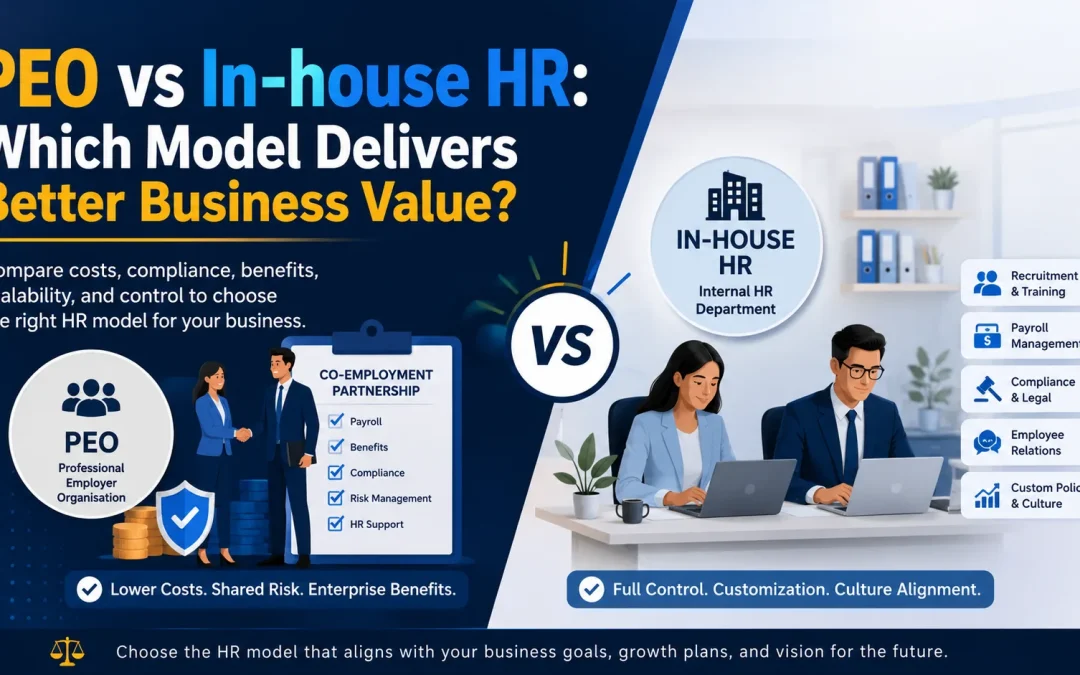
Managing people means being concerned about accurate payroll, new compliance requirements, benefit management, and talent retention. In order to grow, a company must find a solution to all those needs.
Choosing between PEO and In-house HR models becomes a key decision point. Do you want to enter into a relationship with a professional employer organisation to get external expertise and leverage, or do you want to create an internal department focused on your corporate culture?
The choice of PEO vs In-house HR will affect your operating costs, risk profile, and ability to scale. Our guide explores both models to see what kind of model brings more business value.
Also Read: PEO vs. Traditional HR: A Comparative Analysis
Understanding the Concepts of Options
Before conducting any analysis of business value, it is necessary to clearly define both options.
What is a PEO?
When it comes to defining what a PEO is, it should be noted that a professional employer organisation (PEO) is a special type of company that offers HR services under a co-employment arrangement.
Within the co-employment approach, a PEO company acts as the administrative employer of record in terms of tax and benefits while keeping full operational control over employees within your organisation.
Pooling of thousands of employees from different clients enables a PEO company to offer enterprise-level health insurance coverage, process payroll in multi-states and make statutory tax filing.
What is In-House HR?
Then, it is necessary to define what in-house HR. In-house HR means hiring a team of employees for the purpose of internal HR functions within your organisation.
The internal approach allows having full employer status within your organisation. The internal team will take care of all aspects of HR – from recruiting and training to payroll management and communication with authorities.
Don’t Miss: What is insourcing? and What are the Benefits of Insourcing?
PEO vs In-House HR
| Operational Feature | Professional Employer Organisation (PEO) | In-House HR Department |
| Employment Structure | Shared co-employment model. | Single, direct employer model. |
| Cost Dynamics | Predictable monthly fee (flat fee per employee or % of payroll). | Fixed salaries, benefits overhead, and software stack costs. |
| Benefits Buying Power | Enterprise-level health plans via large pooled bargaining. | Individual SMB market rates based solely on internal headcount. |
| Compliance & Liability | Shared legal risk for payroll tax filings and workers’ comp. | 100% internal liability for regulatory compliance and errors. |
| Customization & Culture | Standardized processes across provider frameworks. | High degree of customization tailored to company culture. |
| Technology Infrastructure | Unified, pre-integrated HRIS platform provided. | Requires selecting, buying, and integrating separate software tools. |
Advantages of a PEO
Being aware of the key benefits of PEO engagement enables us to understand better why many small to mid-sized companies select an insource solution.
Quality Corporate Benefits
Small to mid-sized businesses often find themselves at a disadvantage compared to big corporations while trying to attract the best candidates because of the expensive premium rates on the health insurance policies. By creating a PEO relationship, you get a chance to pool all of the client’s workforce into the master benefits plans providing Fortune 500-style health care, dental, vision, life insurance, and 401(k) plans at greatly reduced cost per employee.
Avoiding Penalties and Fines
Laws relating to employment practices are constantly changing. Any mistake in the process of complying with the statutory deadlines or the requirements to overtime regulations may result in huge fines. PEOs have their own compliance specialists who manage workers’ compensation, SUTA, payroll taxes, and labor law compliance for your company.
Reduced Operational Costs
Creating an internal HR department involves recruiting dedicated professionals, such as payroll specialists, benefit specialists, and HR generalists in addition to buying dedicated HRIS systems and software licensing fees. The PEO eliminates this combination of costs and replaces them with one predictable operational cost.
Benefits of In-House HR
Although the PEO provides an administrative advantage, there are several reasons why having an internal HR team provides specific value.
- Alignment with Corporate Culture: Having an internal HR team allows your company to be completely in tune with your corporate culture because they understand your corporate values and office environment, enabling them to customize onboarding processes.
- Complete Control Over HR System: In-house HR lets you have full control over what technology, niche benefit brokers, and workplace policies your HR system uses without being limited to a standard model of the PEO’s.
- Internal Talent Acquisition: The main focus of the PEO is to provide administrative HR services rather than recruit new employees. The internal HR team knows exactly what kind of skills your company needs to acquire.
Risk Allocation and Legal Liability: Co-Employment vs. Sole Liability
Legal Risk Management is one of the crucial aspects of workforces management. The architecture distinction between a PEO vs In-house HR plays a big role in your legal exposure to liabilities.
Co-Employment Compliance Management
In the case when your company is using the Professional Employer Organization services, the risks of compliance will be shared. The PEO takes a legal co-responsibility for such employment liabilities as:
- Payroll Taxes Filing: The PEO pays out the funds with its own FEIN number being responsible for payroll taxes filings;
- Workers’ Compensation Claims: PEOs organize safety programs in the workplace and process workers’ compensation claims via the master policies, thereby protecting your small company from huge insurance rates in case of an accident;
- Multi-State Employment Laws: With your expanding remote workforce, the PEO controls local statutory requirements, required disclosures and leave policies.
In-House HR Legal Liability Exposure
With the help of the internal HR department only, your company carries 100% of the legal liability. HR managers should control the changes in legislation on the federal, state and municipal levels by themselves. In the case when any administrative mistake happens, for example, wrong overtime calculation, wrong tax filing or wrong I-9 forms auditing, your company will have to bear all consequences of the violations.
Scalability and Growth Stages: When to Transition Models
Your company’s headcount trajectory is the most reliable indicator of whether a PEO or In-House HR will deliver better long-term ROI.
Stage 1: The Initial Growth Stage (1-15 Employees)
It makes no financial sense to hire HR staff at this stage. Entering into a PEO relationship ensures immediate access to a professional setup without the need to pay for full-time HR staff.
Stage 2: The Scaling Stage (15-150 Employees)
The ideal stage for a PEO partnership is this one. Benefits management, multi-state payroll and compliance become difficult when managed internally, but you don’t have enough staff internally to negotiate health insurance premiums with the carrier. The most popular strategy for many organisations during this stage is to hire an internal HR manager to take care of organisational culture and recruiting, while the back office work is managed by the PEO.
Stage 3: The Enterprise Stage (150+ Employees)
Once you scale up to having 150-200 employees, the economics will change. Your headcount is big enough that you can start negotiating your own benefit rates with insurance brokers. Your costs per employee for the PEO service may be more than that of maintaining your internal HR department and HRIS tech stack.
Employee Experience and Onboarding Realities
Beyond the issues of compliance and costs, the decision between a PEO vs In-house HR impacts the way your workforce interacts with your organisation.
The PEO Employee Experience
The use of a PEO means that your employees have access to self-service websites, organized on-boarding programs, online pay stubs, and sleek benefits enrollment websites. Yet, as the administrative assistance is provided by a third party, there may be an element of transactionality in addressing certain issues with pay or insurance claims.
The In-House HR Employee Experience
The use of your own HR department means personal assistance for your employees, who will be able to come right down the hall to ask about their benefits issues, workplace disputes, or career development opportunities.
Financial Analysis: Total Cost of Ownership (TCO)
In order to find out which alternative is more financially beneficial for the company, you will have to calculate the full financial implication of each approach.
Cost Model of the In-House HR Approach
Having HR department within the organisation requires huge fixed costs:
- Salary and Benefits: HR managers, payroll clerks, and recruiters usually have high salaries, in addition, there are statutory payroll taxes and costs for benefits.
- Software and Infrastructure: Buying different HRIS software, payroll systems, timekeeping software, and applicant tracking systems means having software costs.
- Legal and Brokers’ Fees: Legal costs associated with hiring an outside labor lawyer for audits and other issues related to labor law arise unexpectedly.
Cost Model of the PEO Approach
There are basically two cost models applied by PEOs:
- Per-Employee-Per-Month (PEPM): Flat monthly fee (usually between $50 and $150 per employee) that does not depend on salaries.
- Percentage of Payroll: The fee is a constant percentage (between 2% and 6%) of the payroll.
It should be mentioned that PEOs are capable of lowering insurance premiums and reducing workers’ compensation due to collective bargaining.
Which Model Is Right for Your Business?
A PEO Makes Sense When:
You have 10 to 150 employees, and your organisation doesn’t have its own internal HR setup.
- You must provide enterprise-level benefits in order to hire top-quality personnel from competitive industries.
- You are working in many states, and your organisation faces multi-state payroll and compliance problems.
- You would like to save time for management from dealing with administrative work in order to concentrate on business development.
Internal HR Makes More Sense When:
- Your organisation has grown above 150 to 200 employees where the internal HR setup becomes economically efficient.
- Customizing the corporate culture is a priority for your organisation.
- Your organisation needs control over the carrier choice, benefits design, and integration with software vendors.
- On-site recruiting teams are required for ongoing internal hiring.
Final Thoughts
Both PEO vs In-house HR models have their respective advantages and disadvantages and cannot be classified as better than one another. The selection of the appropriate structure for human resource management depends on the company size, growth phase, and specific strategies.
If an organisation wants to save money and decrease its administrative costs, it may consider using the help of a professional employer organisation, while for large organisations, developing an in-house HR department is more advantageous.
The analysis of the company growth dynamics, risk appetite, and other aspects will help you choose the best HR management system.
FAQs
Q1. How does PEO differ from Employer of Record (EOR)?
PEO functions under co-employment in markets where your company has a registered entity of its own. The Employer of Record (EOR) hires employees for your business in foreign countries where you lack the registered legal business entity.
Q2. If I team up with a PEO, will I lose control of my business?
No. Under the co-employment arrangement, you have full control over your business. You are responsible for running your operations, hiring, conducting performance evaluations, paying employees, and managing company culture while the PEO takes care of HR backend management.
Q3. Is it possible to run a business together with a PEO and HR manager?
Yes. There are many businesses that hire their own HR directors and work with a PEO simultaneously in order to manage company culture and recruit talents in-house.
Q4. How long would it take to move to a PEO?
It usually takes anywhere from 30 to 60 days to move into a PEO structure. The process requires moving employee data, connecting the payroll system, establishing benefits, and onboarding the employees to the PEO provider’s portal.
Q5. What would happen to my employees’ benefits if my company terminates the PEO agreement?
In case you terminate your PEO agreement, it would be necessary for you to connect with insurance brokers independently, choose HRIS technology independently, and purchase master health insurance.

 Dutch
Dutch  English
  German