
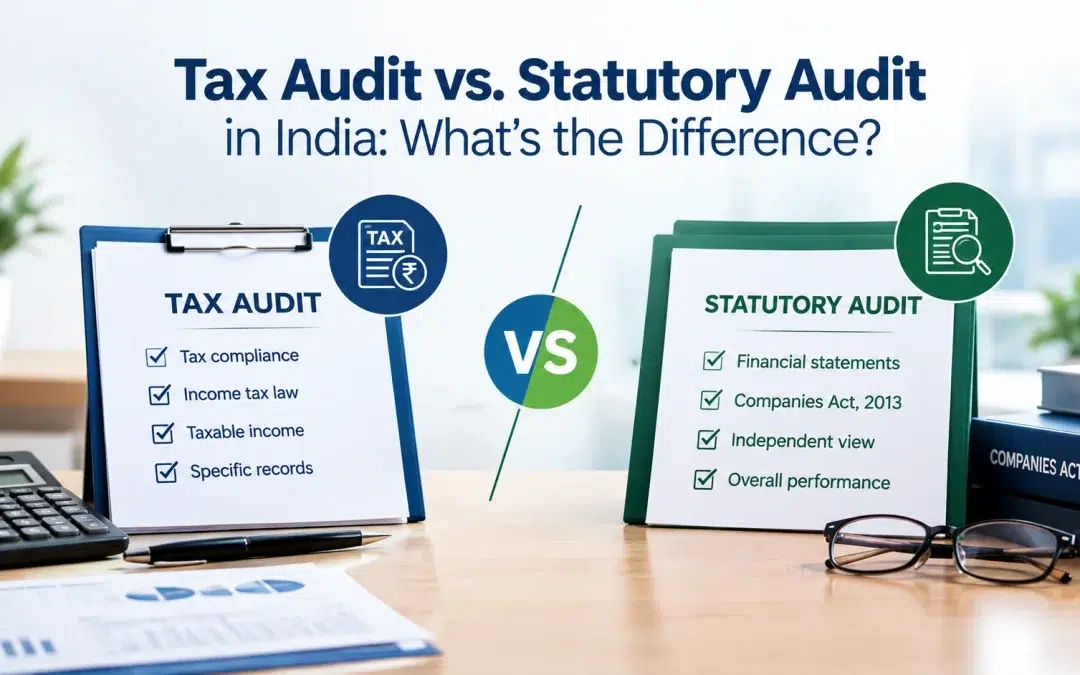
There are several requirements in terms of finance that a business has to adhere to in order to stay in compliance with laws in India. The two terms that commonly cause confusion in this regard are tax audit and statutory audit. These terms refer to different things despite the fact that both imply an audit of financial documents.
Getting acquainted with the distinction between Tax Audit vs Statutory Audit will help businesses to understand which type of audit they have to undergo.
What Is a Tax Audit?
Tax audit refers to the audit of the records and accounts of a taxpayer with regard to some specific information that needs to be verified as per the provisions of the Income Tax Law.
The concept of tax audit meaning is thus related to the compliance with the provisions of the income tax law.
A tax audit does not involve a routine audit of the financial accounts of a firm. Instead, it relates to specific information for ascertaining taxable income as prescribed under the Income Tax Act.
According to the present regime, the provision for tax audit is covered under Section 63 of the Income Tax Act, 2025, which corresponds to the provisions of Section 44AB of the Income Tax Act, 1961. The Income Tax Department has mentioned that there is no change in the threshold limits as such.
The tax audit is conducted by a chartered accountant, and he/she has to prepare and file the tax audit report in the prescribed format. Depending on the requirement of the taxpayer for getting his/her account audited under other statutes, the format may differ.
Simplify tax compliance and audit services with Insource India, covering MCA returns, income tax filing, GST & TDS compliance, ROC filing, and return preparation.
What Is a Statutory Audit?
A statutory audit is an audit that is done on the basis of certain laws or statutes. As far as Indian companies are concerned, the main legislation for statutory audits is the Companies Act 2013.
The statutory audit definition may be taken quite literally, i.e., an independent analysis of a company’s financial statements to find out whether they correctly represent the financial situation and performance of the company according to the applicable legislation and accounting standards.
According to the Companies Act, auditors have to be appointed by the company following Section 139, while Section 143 describes important duties of auditors.
Unlike a tax audit, the main subject of analysis in statutory audit is the company’s financial statements, accounting records, internal financial control system, if any.
Tax Audit vs Statutory Audit: Key Differences
Both types of audits entail scrutiny of financial records, but they are undertaken for different reasons.
| Basis | Tax Audit | Statutory Audit |
| Primary purpose | To examine tax-related information | To give an independent view regarding financial statements |
| Legal basis | Income tax law | Companies Act, 2013, and other relevant laws |
| Area of concern | Taxable income, deductions, expenses, disclosures, and tax information | Accounting and financial statements |
| Relevance | Dependent on tax audit conditions | Dependent on the legal position of the entity and applicable statutory provisions |
| Auditor | Chartered Accountant | Statutory auditor based on the relevant statute |
Both audits may coincide in some respects, in that both will entail examination of the books of accounts and other related documentation. Nevertheless, the objectives of the audits and reporting requirements are different.
Also Read: How PEOs Protect You From Compliance and Legal Penalties
What Is Tax Audit Applicability in India?
One of the essential considerations is the applicability of tax audits for the business
As per the Income Tax Department, for the business sector, the threshold for a tax audit is generally when the total amount of sales, turnover, or gross receipts of the business is more than ₹1 crore. The threshold may rise to ₹10 crore if the cash transactions are up to 5 percent of total transactions of either receipts or payments. In the case of professionals, the threshold amount in terms of gross receipts is ₹50 lakh.
In some cases, there can be an obligation to get a tax audit performed if there has been any presumptive taxation, especially when the taxpayer opts out of the scheme and declares the income at a lower level than the prescribed one.
Hence, only turnover does not decide whether a business needs to undergo a tax audit or not. This depends on other factors too.
Tax Audit Requirements in India
Understanding the audit requirements of taxes in India becomes important in view of the fact that the audit includes more than just verification of whether the books tally or not.
There may be an audit of:
- Books of accounts and supporting records
- Sales and purchases
- Expenses
- Depreciation and fixed assets
- Financial transactions, including loans and others
- Deductions/allowances available
- Information on GST/indirect tax-related particulars wherever required
- Payments having specific tax consequences
- Cash transactions
- Information related to TDS
- Information required to be reported under tax audit provisions
Tax audit reports also require certain specific particulars to be included in them. According to the Income Tax Department of India, the purpose of a tax audit is to ensure proper maintenance and correctness of books along with reporting of specific information as per tax laws.
It is advisable for businesses to maintain proper accounting records throughout the year and not to wait till the time of audit.
What Does a Statutory Audit Cover?
Statutory audits usually encompass a more extensive review of a company’s financial reporting.
The auditor might conduct reviews of:
- Balance sheet
- Profit & loss account
- Cash flows, if any
- Accounting records
- Related invoices and other documentation
- Bank records
- Assets & liabilities
- Inflows & outflows
- Financial controls, if any
- Applicable accounting and legal provisions
The statutory auditor has the authority to access the company’s books of account, accounting entries, vouchers, and other necessary data for the purpose of the audit. Powers and responsibilities of statutory auditors are set out in Section 143 of the Companies Act.
The ultimate aim is to express an independent opinion on the financial statements and other matters that need to be reported under applicable laws.
Why Proper Audit and Tax Compliance Matter
Good records facilitate easier auditing and allow companies to detect any discrepancies before they escalate into serious compliance issues.
Bad documentation can cause delays, inaccurate reporting, failure to claim deductions, problems during assessment, and even penalties or other regulatory issues.
Professional compliance management services in India could assist in handling such obligations in a systematic manner, depending on the requirements of the company. These requirements may include accounting record maintenance, tax filing, tax audit, statutory compliance, documentation, reconciliation, and more.
Insource offers businesses the chance to handle their finances and compliance processes in a more systematic manner and relieve the hassle associated with tax and regulatory obligations.
How Insource Can Help
Taxation and audit compliance can become difficult for companies as they continue to grow. Various rules and guidelines, deadlines, financial statements, and record keeping must all be done correctly.
Insource India will assist businesses with tax and compliance-related issues and help them have organized financial management.
From helping companies understand what is required during an audit to actually conducting audits themselves, Insource can assist companies in managing the process.
Conclusion
Knowledge about tax audits vs. statutory audits is necessary for those enterprises that do business in India. While these two processes entail analysis of financial records, there are differences in the objectives, laws, and nature of application as well as reporting obligations of these audits.
A tax audit is mainly aimed at compliance with tax regulations, whereas a statutory audit is an independent review of the financial statements according to the respective law. A business entity has to observe either of these or both, depending on its organizational structure.
With the help of Insource’s professionals, enterprises can conduct their tax audits and other statutory activities in an organized manner.
FAQ’s
- What is the distinction between a tax audit and a statutory audit?
In a tax audit, attention is given to the requirements in terms of information and reporting according to income tax law, whereas in a statutory audit, attention is given to financial statements and accounting records according to the relevant statutory provisions.
- Is a tax audit compulsory for every business?
No. The necessity of a tax audit is based on issues like turnover or gross receipts, the nature of the taxpayer’s operations, cash transactions, and taxation elections.
- What does statutory audit mean?
A statutory audit is an audit that is performed according to the law where an independent auditor inspects the financial statements and other records of the entity and gives an audit report.
- What does tax audit mean?
A tax audit is an inspection of specific financial records and information with the purpose of reporting specific items required according to income tax law.
- Is the same chartered accountant able to perform both audits?
According to the situation and other considerations, the same chartered accountant might participate in both audits. However, there will be a distinction between the scope and reporting requirements of both.

 Dutch
Dutch  English
  German