
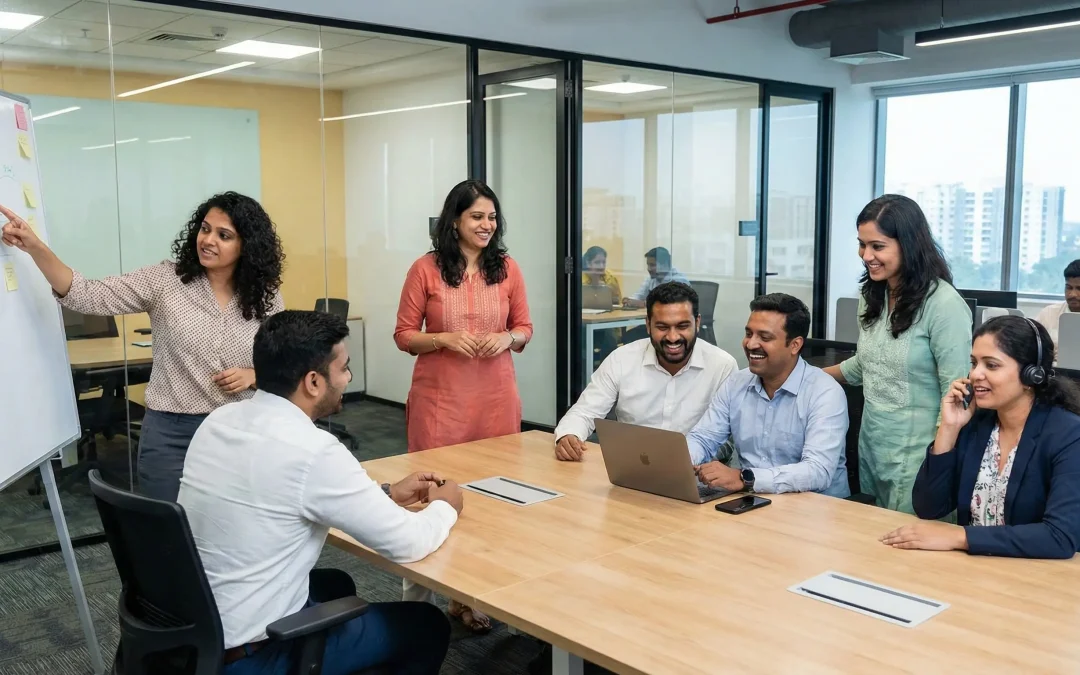
India has quietly become one of the most important talent hubs for global businesses.
From early-stage startups to growing international companies, more teams are choosing India to build engineering, support, operations, and growth functions.
But for many founders, working with Indian culture is also where expectations start to bump into reality.
And very quickly, questions come up. Is working with indian people easy? How do communication styles differ? And how does Indian work culture compare with the US?
In this article, we will look at the expectations vs reality of working with Indian professionals, cultural differences that will help you understand Indians better, along with challenges that will appear and how you can tackle them.
Expectation vs Reality When Working With Indian Professionals
Here are some expectations global companies have from Indian teams:
Expectation: Indian professionals will always say yes
In reality, “yes” often means acknowledgement, not agreement. So when working with people from India, many global managers assume that verbal agreement means that it is a commitment. But that’s not usually the case, as that “yes” might be to:
- Acknowledge instructions
- Show respect
- Avoid immediate confrontation
And now this does not mean dishonestly, but simply the conditioning and cultural leanings. You will notice that open disagreements, especially with seniors or overseas stakeholders is often softened or delayed.
Here is what works better in such a situation: You should ask follow-up questions like, “Do you see any challenges with this?” or “What would you need to deliver this on time?”
Expectation: “Everyone will speak up openly in meetings.”
This is not entirely true. Let us introduce you to the reality behind it. We can talk about it, as we have worked with companies and know the key behind their success is accepting and adapting to this reality. In many indian workplaces, hierarchy still plays a role. This is why junior team members may hesitate to challenge ideas openly, especially in group calls with leadership or international clients.
This is undoubtedly one of the most common cultural differences in India when compared to Western workplaces.
Here is what works better in such a situation:
-
- Invite opinions individually
- Encourage written feedback after meetings
- Reinforce that disagreement is welcome and safe
Expectation: “Indian work culture is the same everywhere.”
In reality, however, India is not one work culture, but a blend of many. Lastly, India is often seen as one big market that runs exactly the same all around.
That’s again not true, as the work culture varies by city, industry, and company maturity. A SaaS engineering team in Bengaluru will operate very differently from a back-office team elsewhere, even though the labour law in India regarding working hours remains consistent.
These internal cultural differences in India directly affect communication styles and collaboration.
Cultural Differences India and the US: A Practical Comparison
It is very important to understand the cultural differences between India and the US if you want a smooth cross-border collaboration. While both cultures value performance, the way teams communicate and make decisions is what differs.
| Aspect | India | United States |
| Communication | Polite, contextual, indirect | Direct, explicit, to-the-point |
| Feedback style | Often private and softened | Open and direct |
| Hierarchy | Respect for seniority | Flatter structures |
| Decision-making | Confirmation and alignment-driven | Individual ownership and speed |
| Disagreement | Expressed carefully | Expressed openly |
This table above will help you understand the most common cultural differences between Indian and US teams when working with Indian people for the first time.
Summary:
Indian workplaces often value indirect communication, hierarchy, and confirmation-based decision-making, while US workplaces prefer direct feedback, flat hierarchies, and faster individual decisions. Once you understand these cultural differences, your global teams collaborate more effectively.
What Working With Indian Culture Really Looks Like
Now that you know about the cultural differences, here is a look at what it truly looks like working with Indian culture. Indian professionals actually perform the best when they are given:
- Clear expectations
- Context behind tasks
- Defined ownership
So, for companies that are working with people from India, please note that trust-building cannot be ignored!
Once the trust is established, Indian professionals will eventually show strong commitment, loyalty, and long-term engagement.
For many, it’s a dream to work in an international organization, so they are already willing to learn, but the culture and space need to respect their conditioning.
This is why many global companies actually continue working with Indian people for extended periods once they go past that initial alignment.
Tips for Better Collaboration
Most challenges when working with Indian professionals arise from misaligned expectations, indirect communication styles, and unaddressed cultural differences rather than a lack of capability or effort. Here is how you can manage it:
- Start with clarity. When expectations, timelines, and responsibilities are clearly laid out, it reduces hesitation and confusion while working with Indian people. Afterall, clear direction is often appreciated more than assuming that people will be flexible when you want them to.
- You should make it easy for them to ask questions. You will notice that working with people from India is actually pretty easy once you make them feel not judged and let them give their opinions openly.
- Another thing you can do is adjust the way you communicate, not just what you say. Being mindful of cultural differences between India and the US, especially around feedback and tone, can literally save you from hundreds of misunderstandings.
- Talking of the cultural differences, you should respect the whole context of it. You can take time to acknowledge the cultural differences in India, instead of ignoring or rushing past them. This will make people feel seen, and might as well improve your retention rate.
- Most collaboration issues come from miscommunication, not effort. That being said, understanding local communication styles will actually solve more problems than pushing teams beyond the maximum working hours in India.
- From compliance and HR to payroll and infrastructure, having an experienced India expansion partner helps you avoid costly missteps. And that’s where we come in to help you step in confidently!
Conclusion
Working with Indian professionals might seem challenging at first due to cultural and time differences, but when approached thoughtfully, it often becomes a powerful growth advantage.
Taking the time to understand and respect working hours in India, setting clear expectations, and building cultural alignment goes a long way in creating teams that are stable, productive, and long-lasting. India’s talent pool is not only vast but globally competitive, which is why companies across the world continue to hire from the region.
However, long-term success depends on clarity, compliance, and mutual trust rather than assumptions. This is where experienced partners like Insource India play a important role. By handling compliant employment contracts, payroll, statutory obligations, onboarding, and ongoing HR support, Insource India enables global companies to hire and manage Indian talent with confidence.
With the right structure and support in place, businesses can focus on growth while ensuring their teams remain engaged, motivated, and committed for the long run.
Frequently Asked Questions
1. What is the Indian working culture like?
Indian working culture is built around collaboration, flexibility, and a strong sense of responsibility toward the team. While respect for hierarchy still exists in many workplaces, there’s a clear shift, especially in tech and startups.
2. Can private companies ask for more than 9 hours a day?
Yes, it can happen occasionally, especially during high-demand periods or project deadlines. That said, any extra hours must follow working hours as per the labour law in India, which means overtime limits and proper compensation are non-negotiable.
3. What is the management style in India?
There’s no single style. Traditional organizations may follow a more hierarchical approach, while startups and global teams lean toward flat structures. What consistently works best is clear direction, context, and trust, far more than micromanagement.
4. How do Indian professionals manage cross-time zone work with UK teams?
Most teams plan a few shared hours during the afternoon to align with UK working hours in India. Outside of that overlap, people usually stick to local schedules, making sure they stay within legal working hours in India while still being available when it truly matters.
5. Is an 8-hour working time in India mandatory?
Yes, 8 hours of working time in India is considered the standard workday under Indian labour laws. While there’s some flexibility depending on the role or industry, this remains the baseline that companies are expected to follow.

 German
  English
  Dutch
Dutch