
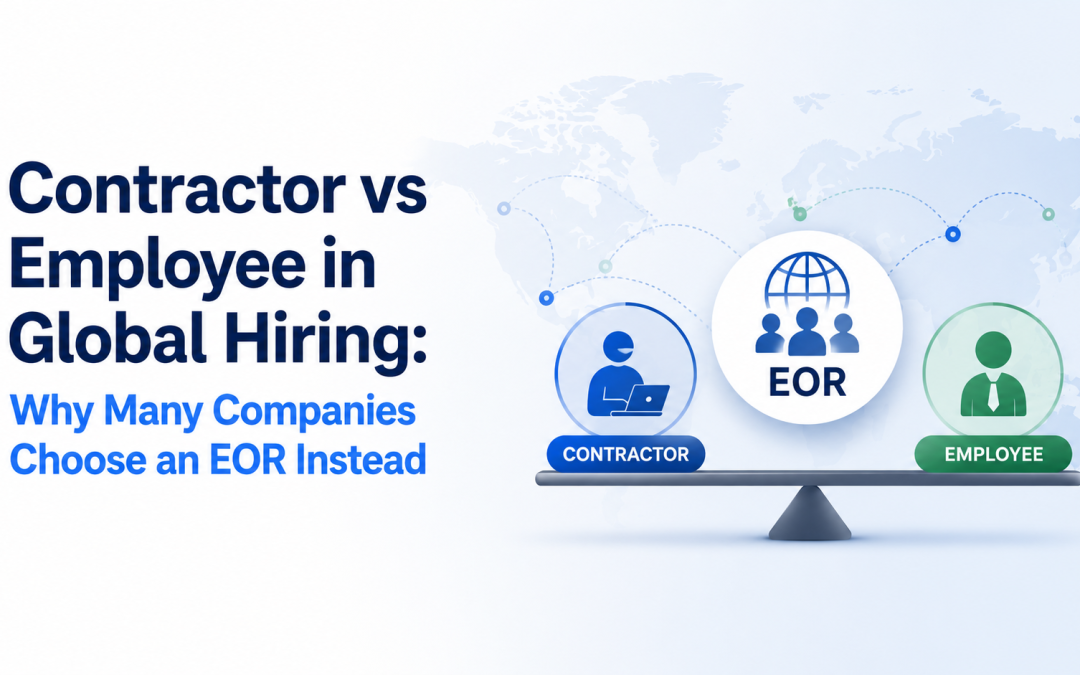
In the race of global expansion, the least resistance path often leads to independent contractors. The new markets are fast and flexible, increasing their minefields. With the global labour authorities tightening their misclassification laws, a simple contractor agreement could turn out to be a liability. It can even stall the expansion of your business in India.
The debate usually centres on contractor vs employee models. It might be quicker to hire an independent contractor than an employee to get your work done. However, there are often hidden complexities that stall your business expansion. With tightening global regulations, more companies look to bypass this dilemma by joining hands with an Employer of Record (EOR) to build an effective ‘insourced’ talent pool.
In this guide, we will explore the fundamental differences between contractor and employee classifications and why you need an effective EOR approach.
The Basics: Independent Contractor vs Employee
Congratulations on aiming for a new global expansion. However, are you fully aware of the local legal and operational definitions that come along? Before you decide on your hiring strategy, you need to understand these two terms better with reference to their roles. A misclassification of anyone could prove to be an expensive mistake that a global company can make.
What is an Independent Contractor?
By definition, an independent contractor is an external service provider. They are hired to support multiple clients, offering their own equipment with significant control over how they complete their tasks. From a company’s perspective, the primary aim is the lack of a long-term commitment to reduce its overall administrative overhead.
What is an Employee?
An employee, on the other hand, is your organisation’s core part. They work exclusively for your organisation using your tools to follow your direct management. Importantly, when you hire an employee, you are responsible for providing them with statutory benefits, tax withholdings, and adherence to local labour laws.
What Are The Hidden Risks of the Contractor Model?
Several businesses initially opt for the contractor versus employee model as it works faster. However, ‘speed’ comes at the expense of your organisation’s legal and cultural stability.
1. Misclassification Threat
Governments these days are becoming increasingly vigilant about how companies are using contractors to avoid taxes and employee benefits. If a local labour board determines that your ‘contractor’ actually functions like an employee, you could end up paying massive fines, face legal complications and back-dated tax penalties.
2. Lack of Cultural Alignment and Ownership
There is a lack of cultural alignment and ownership in the contractual model. Contractors often entangle themselves in multiple projects. They may not even develop a deep sense of connection with your brand, your product and your long-term business goals. As a result, your organisation may not be able to develop a cohesive culture across new geographies.
3. Intellectual Property (IP) Vulnerability
While working on an independent contractor vs employee model, your Intellectual Property (IP) protections might turn unpleasant. A lack of a robust and locally compliant employment contract ensures that every code line or strategic plan stays your exclusive property.
Why Companies are Moving Toward “Insourcing” via EOR
Rather than moving ahead with an unstable contractor or massive overhead norms of setting up a local legal entity, global companies are joining hands with a third party: Insourcing through an Employer of Record (EOR).
What is an EOR?
An Employer of Record or EOR is a legal partner who employs staff for your organisation on its behalf. You do not need a local registered entity for this purpose. The EOR effectively handles all your ‘back-office’ complexities, including taxes, payroll, and compliance. However, the operational control rests fully with your organisation.
Also read : Insourcing vs Outsourcing in India: What Global Companies Should Know
1. No Legal and Compliance Stress
Entering an Indian market often involves complex tax structures and statutory filings. An EOR partner, such as InsourceIndia, works like your legal employer to ensure that your organisation fully complies with every single local regulation. As a result, the employee or independent contractor legal risk is eliminated.
2. Faster Market Entry
A legal entity registration is both time and effort-consuming. There’s a lot of administrative work too. An EOR bypasses you through this tedious process to start hiring on your behalf in weeks.
3. Building ‘Your’ Teams
‘Ownership’ is the greatest advantage of the EOR backed insourcing model. The moment an EOR hires for your organisation, they become ‘your team.’ They invest their time and efforts to understand your product and business better and feel more invested in your company.
How to Hire Employees in India Without Using Contractors
To hire employees in India without needing contractors, foreign companies are turning towards an Employer of Record (EOR). With this approach, the companies can easily bypass the traditional hiring system of Contractor vs. Employee. This traditional hiring system offers a legal framework where EOR functions like an official local employer while the operational control remains 100% with you. An effective EOR rules out the possibilities of misclassification risks associated with the contractors.
Direct hiring without contractors mediation is important in India for:
- Permanent Establishment (PE): Hiring contractors to perform your core business functions might trigger ‘PE’ for your firm. This PE might attract tax liabilities. However, an EOR effectively helps you to mitigate this risk.
- Intellectual Property (IP) Risks: Having EOR in place legally transfers IP to your company via the EOR’s employment contract.
- Compliance Issues: EOR effectively handles your compliance issues related to Labor Code filings like PF, ESI, and Gratuity.
Contractor vs. Employee vs. EOR Insourcing
| Aspect | Independent Contractor | Direct Employee (Local Entity) | Insourced Team (via EOR) |
| Control | Low – they manage themselves | High – you manage them | High – you manage them |
| Compliance Risk | High (Misclassification risk) | Low (But high admin burden) | Lowest (Handled by EOR) |
| Setup Time | Fast | Very Slow (Months) | Fast (Weeks) |
| Company Culture | Weak | Strong | Strong |
| Ownership | External vendor | Internal | Internal |
The Operational Edge: Supply Chain and Logistics
The difference between contractor and employee models becomes evident when you look at the operational functions of each of their supply chain management systems.
Contractors or external vendors may lack the incentive to build deep and trustworthy relationships with the local suppliers on your organisation’s behalf. However, when you insource a team, you hire it through an EOR that acts as your legal hiring entity. They monitor your warehouses, coordinate deliveries and understand networks of local logistics better.
Partnering with an EOR for Global Contractor vs. Employee Hiring
While the contractor vs employee hiring remains a big debate, it could cost a lot in terms of cost and control. The reality of global expansion is more complex than you can imagine. Relying on contractors managed by an external vendor could be vulnerable to your organisation’s legalities and your turnover. Conversely, setting up your own legal entity today would drive your business expansion slowly.
Choosing to partner with a robust EOR such as InsourceIndia, you get the best advantages of both sides. You have a dedicated local team that stays loyal to your organisation without stressing to manage its complexities, HR, compliance and infrastructure.
Are you ready to build your local Indian team to support your business expansion without facing legal hassles? Get in touch with InsourceIndia today to convert your contractors to compliant employees in India.
FAQs About Contractor vs Employee in Global Hiring
Q1. What is the main difference between a contractor and an employee in global hiring?
The main difference between contractor and employee is the control and legal responsibilities. While employees work under your direct supervision and are entitled to statutory benefits, contractors are independent entities contributing to their own taxes and tools.
Q2. Why do companies prefer an EOR over hiring independent contractors?
Companies prefer to join hands with an EOR to avoid misclassification risks. This combined effort builds a more stable and committed workforce. An EOR offers the benefits of full-time employees. You retain your knowledge within your premises to culturally align with your organisational goals.
Q4. Does an EOR handle payroll for international employees?
Yes. An EOR handles all the local payroll, statutory filings and tax withholdings so that your team receives their payment accurately to comply with the local labour laws.
Q5. How does an EOR support ‘Permanent Establishment?’
Permanent Establishment or PE is a local tax concept where the local authorities define the stability of your business to apply local corporate taxes. Hiring multiple contractors or unregistered employees might trigger PE. An effective EOR mitigates this as it is your local legal partner to shield your parent company from unintended corporate tax liabilities.
Q6. Who has control over the Intellectual Property (IP) created by an EOR-managed team?
The EOR contract has airtight clauses to ensure that any Intellectual Property (IP) generated by the employee of your hired team member automatically stays with you. It ensures a similar protection as registering your direct local subsidiary.
Q7. Can I convert my existing contractor into an EOR-managed employee?
Yes, an EOR offers you this benefit to convert your existing contractor to an EOR-managed employee to grant them benefits, stability and a formal career path to grow.

 German
  English
  Dutch
Dutch