
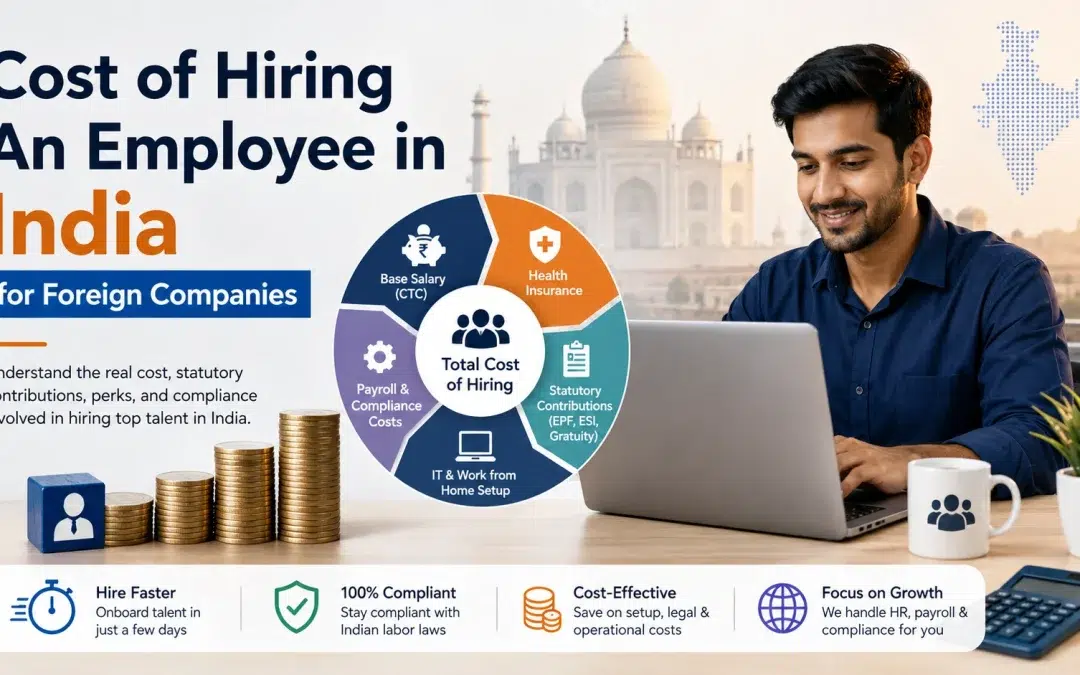
India has emerged as one of the most sought-after locations for companies wanting to expand internationally. The abundant pool of talents, great English language proficiency, and technical proficiency in foreign companies’ hiring in India will help them create an exceptional team.
Unfortunately, many foreign employers make the same mistake as far as their financial calculations are concerned. While estimating their budgets for international expansion, they consider only the base salaries without considering other costs which are mandatory in India.
It is crucial to know the real cost of hiring an employee in India for your financial planning purposes. Here is an elaborate guide that takes into account all the hidden costs associated with hiring a person in India.
Don’t Miss: True Cost of EOR Services: Hidden Fees You Need to Know
Indian Compensation Landscape
In your research regarding employee compensation costs in India, you are likely to come across the term CTC (Cost to Company).
Unlike Western employee compensation structures, which have distinct base salaries and additional benefit packages, the Indian CTC structure consists of nearly all benefits, allowances, and contributions rolled into one single figure.
Components of Indian Salary Packages
- Basic Salary: Consists of 40% to 50% of the total CTC. This is what provides a basis for determining statutory benefits such as provident funds and gratuity.
- House Rent Allowance (HRA): 40% to 50% of the basic salary helps employees cover their housing costs.
- Additional Allowances: Flexible compensation elements included in the total compensation package.
- Performance Bonuses: Annual or quarterly bonuses for achieving personal and organizational goals.
Mandatory Statutory Contribution Summary
Besides the basic salary, there are statutory contributions that the Indian labor laws mandate an employer to provide in his budget for. These contributions usually range from 15% to 25% of the salary.
| Statutory Component | Legal Requirement | Employer Contribution Rate | Who Qualifies? |
| Employee Provident Fund (EPF) | Mandatory retirement savings pool. | 12% of Basic Salary + DA. | Mandatory for monthly basic pay up to ₹15,000; common for all corporate roles. |
| Gratuity Pay | Statutory end-of-service payout. | ~4.81% of Basic Salary (accrued annually). | Employees with 5+ years of continuous service. |
| Employee State Insurance (ESI) | Mandatory state medical insurance. | 3.25% of gross wages. | Workers earning up to ₹21,000 gross monthly. |
| Paid Statutory Leave | Mandatory annual and festival leave. | 100% paid time off (15 to 24 days annually). | All full-time formal employees. |
1. Employee Provident Fund (EPF)
It is a social security program administered through the Employees’ Provident Fund Organization (EPFO). The contribution from the employer matches that of the employee at the rate of 12% of basic salary. A share of this contribution goes towards the Employee Pension Scheme (EPS) whereas the remaining amount is credited to the savings account of the employee.
2. Statutory Gratuity Liability
According to the Payment of Gratuity Act, a person becomes eligible for statutory gratuity after he completes five continuous years of employment with a firm. It amounts to 15 days of basic salary per year of service. In the case of smart international firms, the percentage of annual contribution towards gratuity is about 4.81% of basic salary.
3. Employee State Insurance (ESI)
The Employee State Insurance scheme provides healthcare and monetary benefits to poor employees. If an employee earns up to ₹21,000 gross salary per month, the employer is required to make a contribution of 3.25% of gross salary to the state insurance fund.
Supplementary Perks and Workplace Standards
When recruiting employees in India, foreign firms must provide perks that exceed what is required by law to compete for the best employees.
Private Group Health Insurance
Although there is public healthcare available, skilled workers require private group mediclaim insurance. Premium policies can insure the employee, spouse, offspring, and even dependent parents. Private health insurance adds about $300 to $600 to each employee yearly.
Work from Home Setup and Hardware
Providing essential hardware is one of the basic costs associated with handling remote work from overseas:
- Laptop and Equipment: High-end laptops, additional monitors, and equipment would cost somewhere between $1,200 to $2,500 initially on an individual basis.
- Home Office Allowance: Giving employees a monthly allowance for internet and setting up home offices ($50 to $100 per month) allows them to stay productive.
The Actual Cost of Hiring: Real World Scenarios
Let us try to understand the cost of hiring employees by comparing two common hiring scenarios in India for a foreign tech firm.
Also Read: How Much Does PEO Cost In India?
Scenario A: Senior Software Engineer Position in India
- Base Annual CTC Salary: $30,000 (approx. ₹2,500,000)
- Employer EPF and Statutory Contributions: $2,200
- Group Health Insurance (Family Plan): $500
- IT Equipment (3 year amortization): $600
- EOR Management / Payroll Processing Charges: $3,600 ($300 per month)
- Real Cost Estimate: $36,900 annually (approximately 23% above base CTC salary)
Scenario B: Customer Support Specialist
- Base Annual CTC Salary: $10,000 (approx. ₹830,000)
- Employer EPF and Statutory Contributions: $850
- Group Health Insurance: $350
- IT Hardware Costs
Costs Involved in Hidden Compliance
Direct expansion without proper infrastructure entails legal and regulatory costs, which can add up quickly.
Taxing Corporate Activities as a PE
Foreign corporations managing staff in India directly without forming a proper corporation may be considered a PE, meaning that your parent company will be subject to tax, arrears, and heavy fines.
Misclassified Workers
Hiring employees in India as contractors to avoid paying statutory benefits if they work as regular employees is illegal. Failure to pay for these benefits, if you get caught by labor authorities, means heavy fines.
How to Employ People in India?
The foreign employers usually consider one of the following ways to employ people in India:
1. Setting up a Local Corporate Entity (Private Limited Company)
To set up an Indian corporate entity gives you full control over the company’s operations. The drawback of this approach is that the entity setting process takes considerable time – from 3 to 6 months and costs about $15,000-$30,000. Therefore, this method is better for the company that plans to employ 50-100 or more workers in India.
2. Employment of Independent Contractors
Employment of independent contractors in India is fast and does not require any entity registration. But at the same time, this method is risky in terms of worker misclassification since the contractor will work full-time under your supervision.
3. Cooperation with an Employer of Record (EOR)
The cooperation with EOR is the optimal choice for most companies if they want to employ people in India in a fast and safe way. The EOR will be the employer in the eyes of law, and it will handle all the paperwork. At the same time, you will control the employee’s activities directly.
Strategic Benefits of Utilizing an EOR in India
- Quick Market Penetration: Hire and engage employees while signing employment agreements compliantly within 48 hours.
- No Entity Creation Expenses: Save yourself from having to spend thousands of dollars on entity creation, legal retainers, and accounting systems.
- Total Labor Law Compliance: EORs ensure that you’re always compliant with the ever-changing labor laws both centrally and at the state level.
- Global Payroll Made Easy: Get your Indian workers paid in INR via one consolidated invoice from your EOR partner.
Create Your Indian Workforce Easily Using InsourceIndia
If you find yourself struggling with the regulations associated with hiring people in India, then it needn’t hinder your plans of expanding your business across international borders. Let InsourceIndia ease your way into the Indian marketplace through their full-service range of Employer of Record (EOR), PEO, recruiting, and entity services.
Establish a dedicated offshore team in India with InsourceIndia, lowering operational expenses while we manage recruitment, workplace logistics, and daily operations for you.
Conclusion
Knowing the true cost of hiring an employee in India means looking further than simple salaries. Considering factors such as Employee Provident Fund, Gratuity calculations, group health insurance, among others, will allow foreign companies to plan their budgets realistically.
If your company is looking for the most effective method of hiring employees in India, which will take away months of establishing legal entities locally, an EOR will be your optimal choice. By considering all costs involved in foreign hiring from India, you will successfully build a global team.
FAQs
Q1. What would be the average cost of hiring over the base salary in India?
The total cost of statutory deductions, insurance and other charges usually come in the range of 15% to 30% over the base salary of an individual in India.
Q2. Can a foreign company hire Indian employees without setting up a presence in India?
No, a foreign organization cannot directly hire Indian citizens on the payroll of the company without having its legal presence in India. Foreign companies have to go for the EOR option for legal hiring in India without setting up their presence.
Q3. What is the difference between CTC and take-home pay in India?
CTC includes basic salary, allowances and bonus plus statutory deductions paid by the employer. The difference between the CTC and take-home pay includes income tax (TDS) and other statutory deductions paid by the employee.
Q4. Is there a need to provide health insurance to employees in foreign companies hiring from India?
Although health insurance (ESI) is mandated in case of employees earning less than ₹21,000 per month, offering private health insurance as a group cover is expected by highly-skilled professionals and forms an integral part of attracting and retaining talent.
Q5. How quickly can an employee be on-boarded in India with the help of an EOR?
Through the EOR platform, foreign companies can create localized contracts, do statutory registration, and successfully on-board employees within just 2 to 3 business days.

 German
  English
  Dutch
Dutch